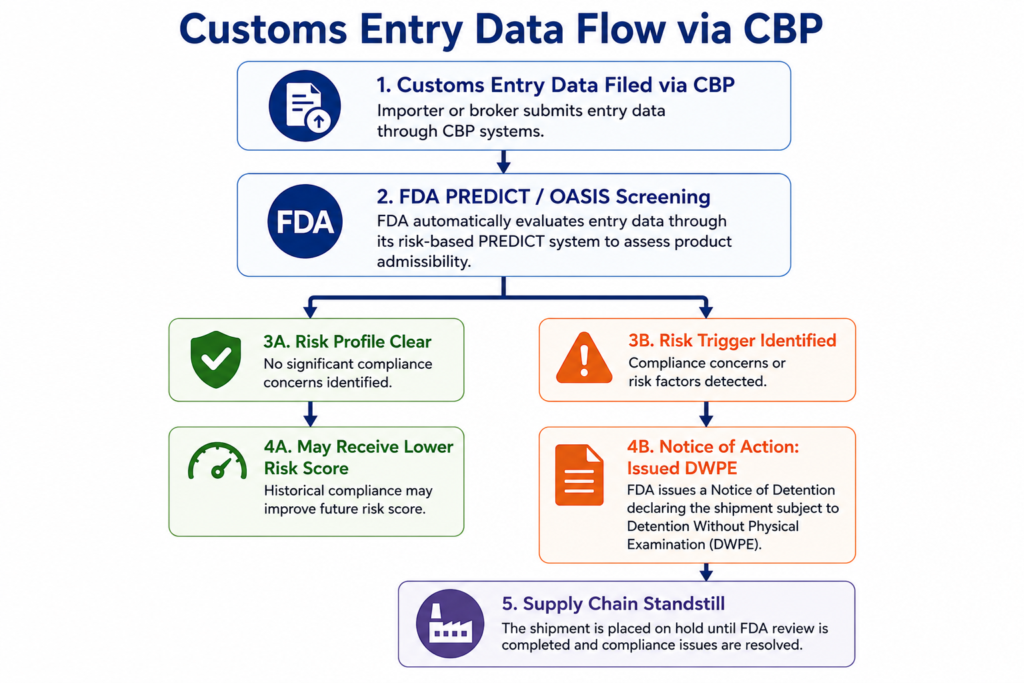
2. Core Operational Pillars: Food, Supplement, and Cosmetic Vulnerabilities
Our firm focuses exclusively on non-medical consumer products, allowing us to maintain a deep technical understanding of the specific analytical chemistry, microbiology, and manufacturing standards required to overcome detentions in the food, beverage, supplement, and cosmetic sectors.
Human Foods & Agricultural Products (Series 09 through 42, 45, 46, 50, 52)
The food sector faces the highest volume of automated border detentions due to environmental contaminants, processing flaws, and rigorous tracking mandates. We routinely resolve complex detentions involving:
- Pathogen Contamination: Defending products flagged for Salmonella, Listeria monocytogenes, or Shiga toxin-producing E. coli (STEC).
- Heavy Metal Restrictions: Navigating border detentions driven by trace elements of lead, cadmium, mercury, or arsenic in raw agricultural inputs and botanical extracts.
- Illegal Pesticide Residues: Overcoming automatic flags where agricultural commodities contain residues that violate EPA tolerances or lack established U.S. maximum residue limits (MRLs).
- Insanitary Conditions: Managing processing violations where the FDA asserts that a foreign facility fails to maintain adequate environmental safety protocols or preventive controls.
Dietary Supplements & Bulk Ingestibles (Series 54)
Dietary supplements enter the U.S. market under the rigid framework of the Dietary Supplement Health and Education Act (DSHEA). The FDA utilizes aggressive import screening to block products that violate manufacturing rules or product integrity:
- Current Good Manufacturing Practice (cGMP) Failures: Resolving detentions stemming from a foreign facility’s failure to document strict identity, purity, strength, and composition testing for bulk raw materials or finished dosages.
- Adulteration via Hidden Ingredients: Clear border holds triggered by suspected product spiking or the presence of unapproved active pharmaceutical ingredients (APIs).
- New Dietary Ingredient (NDI) Verification: Proving to border authorities that an imported botanical or dietary ingredient is legally grandfathered or supported by an active, non-objected NDI 75-day notification.
Cosmetics & Topical Skincare (Series 53 & 70+)
Enforcement under the Modernization of Cosmetics Regulation Act (MoCRA) requires international beauty brands to meet stringent oversight baselines. Common compliance barriers include:
- Unapproved or Undeclared Color Additives: Rectifying detentions caused by the use of synthetic colorants that lack proper FDA batch certification or are restricted from specific application zones (such as eye-area cosmetics).
- Microbial Bio-Burden: Addressing cargo held due to high total aerobic plate counts or the presence of opportunistic pathogens like Pseudomonas aeruginosa or Staphylococcus aureus.
- Misbranding via Drug Claims: Re-engineering labeling structures for imported anti-aging serums, acne products, or skin-brightening preparations that face border stops because their packaging claims cross the legal line into “unapproved new drug” classifications.
3. The Science of Release: Navigating the FDA LAAF Program
When a product is placed under DWPE, the FDA will not physically open the container or sample the product themselves. The burden falls entirely on the importer to prove the specific lot is safe and compliant. Under the Food Safety Modernization Act (FSMA), this evidence must be generated through the strict Laboratory Accreditation for Analyses of Foods (LAAF) program.
[Importers Handed a DWPE Notice]
│
▼
[FDA Consults Deploys Certified Courier]
│
▼
[Strict Sampling per FDA IOM Standards]
│
▼
[Analysis at LAAF-Recognized Lab Partner]
│
▼
[Data Packages Transmitted Electronically via ITACS]
To satisfy the agency’s strict evidentiary rules, our firm deploys a standardized sampling and analysis protocol:
- Independent Sampling Execution: We coordinate with professional, independent samplers who physically inspect the detained lot at the port of entry or bonded warehouse. The collection must strictly adhere to the rigorous sampling methodologies detailed in the FDA Investigations Operations Manual (IOM) to prove that the samples are truly statistically representative of the entire shipment volume.
- LAAF-Recognized Chain of Custody: The collected samples are sealed under a strict, legally defensible chain of custody and transported directly to our partner laboratories. These laboratories must hold active ISO/IEC 17025 accreditation and formal FDA LAAF recognition for the specific analyte and commodity in question.
- Comprehensive Data Compilation: The testing laboratory performs the required analysis using officially recognized FDA BAM (Bacteriological Analytical Manual) or AOAC international testing frameworks. We compile the resulting raw analytical data, analyst work sheets, method validations, and sampling logs into a comprehensive evidentiary package. This complete file is transmitted directly to the FDA reviewing division via the Import Trade Auxiliary Communications System (ITACS) to secure a swift release of the specific commercial lot.