Skip to main contentSkip to footer

FCE Registration & SID Process Filing Services

Food Canning Establishment (FCE) & SID Process Filing Services

For international food manufacturers, exporting shelf-stable, low-acid, or acidified foods to the United States represents an incredibly lucrative market expansion. However, it also subjects your facility to some of the most unforgiving regulations enforced by the U.S. Food and Drug Administration (FDA).

If your company manufactures canned goods, glass-jarred sauces, or modern retort pouches, you cannot legally import into the U.S. without securing a Food Canning Establishment (FCE) registration and an accompanying Submission Identifier (SID) for every single product variation.

At FDA Consults, we provide end-to-end regulatory oversight, taking the technical complexity of process filings off your shoulders so your shipments pass through U.S. Customs and Border Protection (CBP) without delays, detentions, or costly liquidations.

FCE Registration & SID Process Filing Services

What are FCE and SID? Understanding the Regulatory Mandate

The FDA enforces strict controls over shelf-stable foods packed in hermetically sealed (airtight) containers. The primary public health objective is the absolute prevention of Clostridium botulinum spores, which can thrive in anaerobic (oxygen-free) environments and produce deadly botulinum neurotoxins.

To manage this risk, the FDA tracks compliance through a dual-layered registration system:

  • Food Canning Establishment (FCE): This is a unique registration number assigned directly to the physical manufacturing location. It proves to the FDA that your facility processes low-acid or acidified foods and is subject to specialized federal oversight.
  • Submission Identifier (SID): This is a unique code assigned to a specific product, formulation, processing method, and packaging size. Every single item you export must have its own SID. If you manufacture a shelf-stable sauce in both a 250ml glass jar and a 500ml glass jar, you must file and receive two separate SIDs.

Do You Legally Require an FCE Registration?

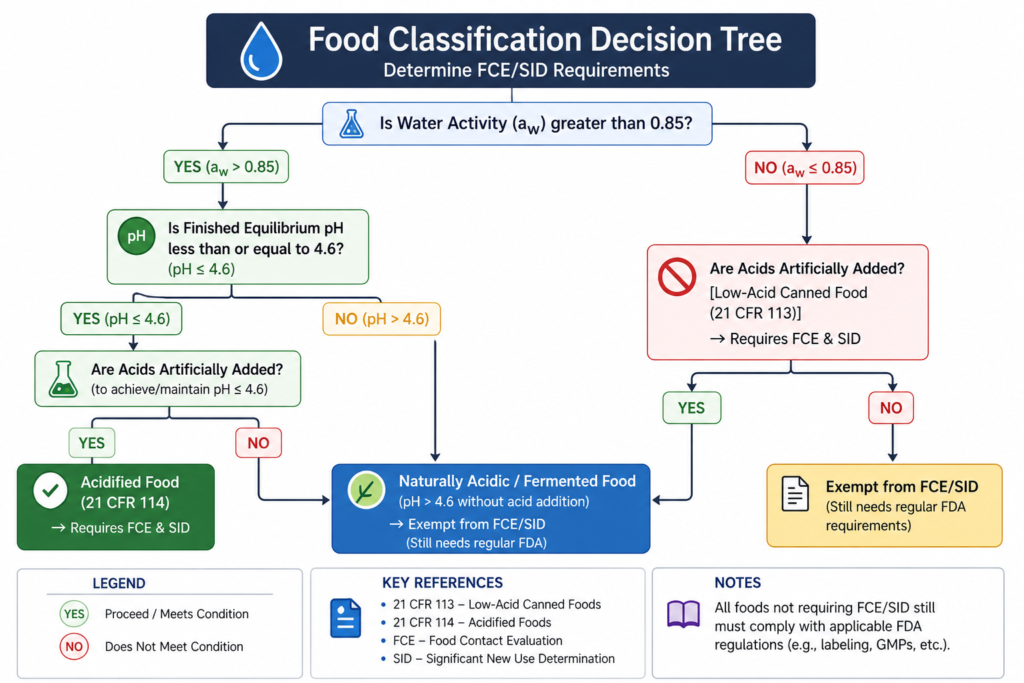
Not all shelf-stable foods require an FCE. The FDA divides products strictly based on their physical chemistry: equilibrium pH and water activity (aw). Misclassifying your product is one of the most common reasons foreign shipments are rejected at the U.S. border.

FDA Low-Acid and Acidified Food Registration Requirement Flowchart for Food Exporters

Let’s Work Together

If you are preparing to enter the U.S. market or need reliable FDA registration and U.S. Agent support, our team is ready to assist you. Contact FDA Consults today to discuss your compliance needs.

1. Acidified Foods (Governed by 21 CFR Part 114)

Acidified foods are low-acid foods to which acid(s) or acid food(s) are artificially added to lower the final pH. They have:

  • A finished equilibrium pH of 4.6 or below.
  • A water activity (aw) greater than 0.85.
  • Examples: Pickled vegetables, hot sauces, salsa, marinated artichokes, barbecue sauces, and certain pestos.

2. Low-Acid Canned Foods / LACF (Governed by 21 CFR Part 113)

Low-acid foods are foods (excluding alcoholic beverages) that naturally have a high pH and a high water activity level. They have:

  • A finished equilibrium pH greater than 4.6.
  • A water activity (aw) greater than 0.85.
  • Examples: Retort pouch ready-to-eat curries, canned seafood (tuna, mackerel), canned meats, canned coconut milk, canned beans, and shelf-stable soups.

Critical Regulatory Exemptions

Your product may be exempt from FCE/SID mandates if it falls under specific criteria, such as having a water activity of 0.85 or less, being naturally acidic (like citrus juices), or being a naturally fermented food (like traditional kimchi or sauerkraut) where the acid is generated organically by bacterial cultures over time.

⚠️ Warning on Fermentation: The FDA closely monitors fermented foods. If you standardize or accelerate your fermented product by splashing vinegar or citric acid into the batch before packaging, the FDA legally reclassifies it as an Acidified Food, stripping your exemption and demanding immediate FCE/SID compliance.

Our End-to-End FCE & SID Compliance Process

Filing a process with the FDA requires highly specific scientific data. A single typo regarding container dimensions or critical factors can result in an automatic rejection by the FDA’s electronic system. We manage this process using a proven, rigorous framework:

01

Product Characterization and Lab Data Audit

We review your complete product formulation, ingredient ratios, and exact lab metrics. We verify your equilibrium pH testing methods and water activity measurements to definitively determine whether your product legally falls under 21 CFR 113, 21 CFR 114, or qualifies for an official exemption.

02

FCE Facility Registration Setup

We interface with the FDA’s Electronic Regulatory Submission (ERS) portal to establish your physical facility profile. We handle the entire application to secure your official Food Canning Establishment (FCE) number, linking it directly to your mandatory FDA Food Facility Registration (FFR).

03

Process Authority Coordination & Thermal Validation

The FDA will not approve an SID without validation from a recognized Process Authority. We compile your operational metrics—including your cooking processes, minimum initial temperatures, filling temperatures, retort settings, or hot-fill-hold parameters. We work hand-in-hand with a trusted Process Authority to issue an official Scheduled Process Letter establishing the scientific lethality (F0 value) of your method.

04

Drafting & Submitting Form FDA 2541

We translate your Scheduled Process Letter into the complex, highly coded FDA filing forms. We prepare and submit Form FDA 2541e for Acidified Foods or Form FDA 2541d for Low-Acid Canned Foods. This includes detailing exact container dimensions (e.g., 307 x 409), critical factors (like consistency, viscosity, or head-space), and commercial sterilization mechanics.

05

Secure SIDs and Update Customs Manifests

Once the FDA reviews and accepts the submission, they issue an official Submission Identifier (SID). We deliver your complete digital compliance portfolio and ensure your logistical team or customs broker links these exact SIDs to your automated import filings, allowing your shipments to clear U.S. ports of entry smoothly.

Why International Manufacturers Choose FDA Consults

Navigating the intersection of food science and federal law is incredibly stressful. Choosing an outsourced regulatory partner ensures your operational investment is protected.

Zero-Error Technical Translators: We understand how to read a Process Authority letter and accurately translate complex thermal parameters into the dense, highly coded fields of the FDA’s electronic database.

Active Import Protection: When a customs broker submits an entry to U.S. Customs, the FDA’s automated PREDICT system instantly screens the manifest against the FCE/SID database. If there is a single discrepancy—such as your shipping invoice reading “300ml pouch” but your SID filing specifying “250ml pouch”—the system will flag your cargo for automatic border detention. We ensure absolute consistency across all regulatory touchpoints.

Rapid Turnaround Management: Left alone, navigating a rejected or deficient SID filing can add months to your commercial timeline. We monitor your applications actively, addressing FDA clarification requests immediately to keep your market launch on schedule.

Ready to Secure Your U.S. Market Compliance?

Do not guess when it comes to federal food safety mandates. A single administrative oversight can result in border detentions, destroyed inventory, and ruined relationships with U.S. distributors. Let our specialized food compliance consultants handle your paperwork with absolute precision.


🔹 Compliance Disclaimer

FDA Consults is an independent consulting firm and is not affiliated with or endorsed by the U.S. Food and Drug Administration. Our services do not constitute approval, certification, or legal representation.