Skip to main contentSkip to footer

FDA Import Detention & DWPE Removal Services

Complete Guide to FDA Import Detentions & DWPE Removal Services

When an international manufacturer, U.S. importer, or customs broker receives a formal Notice of Action from the U.S. Food and Drug Administration (FDA) indicating a shipment has been placed under Detention Without Physical Examination (DWPE), it triggers an immediate operations crisis. Under Section 801(a)(3) of the Federal Food, Drug, and Cosmetic (FD&C) Act, the FDA possesses the absolute legal authority to detain and refuse admission to any product that merely appears to violate U.S. safety, labeling, or manufacturing regulations. This “appearance standard” shifts the burden of proof entirely onto the commercial importer.

To secure the release of detained consumer products and permanently remove a foreign facility from an active FDA Red List, firms must navigate a complex, highly coordinated regulatory pathway involving rapid automated risk systems, third-party port logistics, and accredited laboratory testing.

At FDA Consults, we provide elite, data-driven regulatory representation for the food, beverage, dietary supplement, and cosmetic industries. We act as your specialized technical liaison, managing the precise administrative, and scientific protocols required to defend your U.S. market access, prevent costly cargo destruction mandates, and systematically clear your supply chain.

FDA Import Detention & DWPE Removal Services

1. The Anatomy of an Import Crisis: Automated Flags & DWPE Mandates

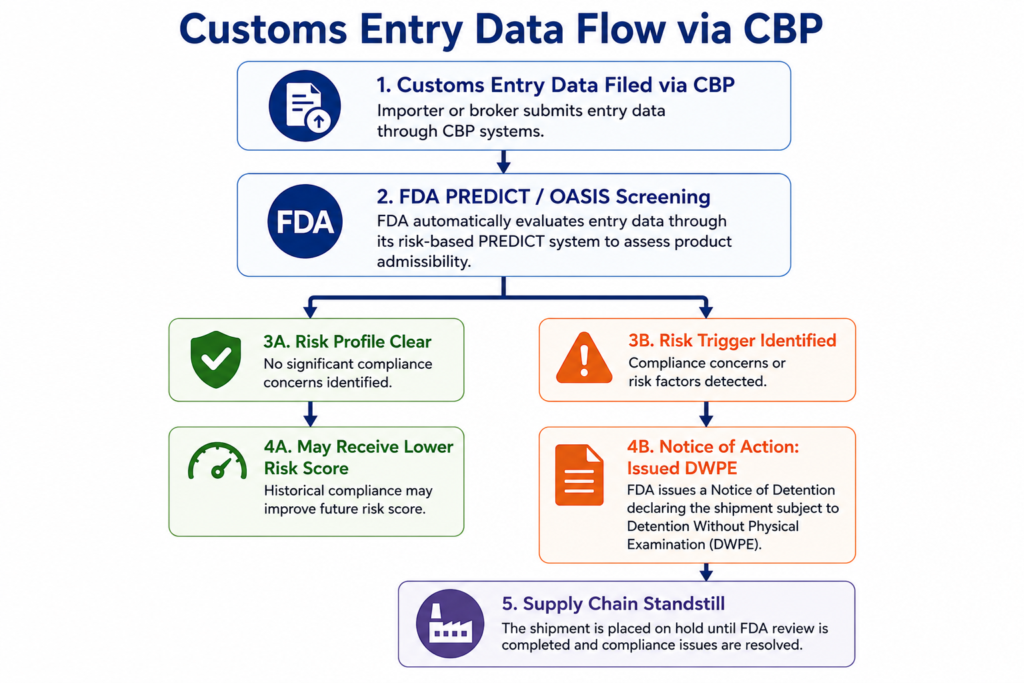
The modern U.S. border is governed by advanced algorithmic enforcement. When electronic entry data is transmitted by a customs filer to U.S. Customs and Border Protection (CBP), it is instantly routed to the FDA’s core screening infrastructure: the FDA ImportShield Program (FISP) and the advanced System for Entry Review and Import Operations (SERIO+).

If a foreign facility or a specific commodity matches an active global surveillance profile, has an undocumented risk background, or is listed on an active Import Alert, the SERIO+ system flags the entry. The importer is issued an official Notice of Action stating that the cargo is subject to Detention Without Physical Examination (DWPE). From this moment, the clock begins ticking on a strict, statutory response window (typically 10 to 20 business days). Failure to introduce validated, legally compliant evidence within this timeline will result in an automatic Notice of Refusal, requiring the immediate re-exportation or physical destruction of the inventory.

Flowchart showing the FDA PREDICT and OASIS screening process for customs entry data leading to a DWPE Notice of Action

Initiate Your Detention Review

If your organization has received a Notice of Action, is facing an active border hold, or needs a strategic pathway to achieve removal from an FDA Red List, contact our compliance officers today to secure technical representation.

2. Core Operational Pillars: Food, Supplement, and Cosmetic Vulnerabilities

Our firm focuses exclusively on non-medical consumer products, allowing us to maintain a deep technical understanding of the specific analytical chemistry, microbiology, and manufacturing standards required to overcome detentions in the food, beverage, supplement, and cosmetic sectors.

Human Foods & Agricultural Products (Series 09 through 42, 45, 46, 50, 52)

The food sector faces the highest volume of automated border detentions due to environmental contaminants, processing flaws, and rigorous tracking mandates. We routinely resolve complex detentions involving:

  • Pathogen Contamination: Defending products flagged for Salmonella, Listeria monocytogenes, or Shiga toxin-producing E. coli (STEC).
  • Heavy Metal Restrictions: Navigating border detentions driven by trace elements of lead, cadmium, mercury, or arsenic in raw agricultural inputs and botanical extracts.
  • Illegal Pesticide Residues: Overcoming automatic flags where agricultural commodities contain residues that violate EPA tolerances or lack established U.S. maximum residue limits (MRLs).
  • Insanitary Conditions: Managing processing violations where the FDA asserts that a foreign facility fails to maintain adequate environmental safety protocols or preventive controls.

Dietary Supplements & Bulk Ingestibles (Series 54)

Dietary supplements enter the U.S. market under the rigid framework of the Dietary Supplement Health and Education Act (DSHEA). The FDA utilizes aggressive import screening to block products that violate manufacturing rules or product integrity:

  • Current Good Manufacturing Practice (cGMP) Failures: Resolving detentions stemming from a foreign facility’s failure to document strict identity, purity, strength, and composition testing for bulk raw materials or finished dosages.
  • Adulteration via Hidden Ingredients: Clear border holds triggered by suspected product spiking or the presence of unapproved active pharmaceutical ingredients (APIs).
  • New Dietary Ingredient (NDI) Verification: Proving to border authorities that an imported botanical or dietary ingredient is legally grandfathered or supported by an active, non-objected NDI 75-day notification.

Cosmetics & Topical Skincare (Series 53 & 70+)

Enforcement under the Modernization of Cosmetics Regulation Act (MoCRA) requires international beauty brands to meet stringent oversight baselines. Common compliance barriers include:

  • Unapproved or Undeclared Color Additives: Rectifying detentions caused by the use of synthetic colorants that lack proper FDA batch certification or are restricted from specific application zones (such as eye-area cosmetics).
  • Microbial Bio-Burden: Addressing cargo held due to high total aerobic plate counts or the presence of opportunistic pathogens like Pseudomonas aeruginosa or Staphylococcus aureus.
  • Misbranding via Drug Claims: Re-engineering labeling structures for imported anti-aging serums, acne products, or skin-brightening preparations that face border stops because their packaging claims cross the legal line into “unapproved new drug” classifications.

3. The Science of Release: Navigating the FDA LAAF Program

When a product is placed under DWPE, the FDA will not physically open the container or sample the product themselves. The burden falls entirely on the importer to prove the specific lot is safe and compliant. Under the Food Safety Modernization Act (FSMA), this evidence must be generated through the strict Laboratory Accreditation for Analyses of Foods (LAAF) program.

[Importers Handed a DWPE Notice]


[FDA Consults Deploys Certified Courier]


[Strict Sampling per FDA IOM Standards]


[Analysis at LAAF-Recognized Lab Partner]


[Data Packages Transmitted Electronically via ITACS]

To satisfy the agency’s strict evidentiary rules, our firm deploys a standardized sampling and analysis protocol:

  1. Independent Sampling Execution: We coordinate with professional, independent samplers who physically inspect the detained lot at the port of entry or bonded warehouse. The collection must strictly adhere to the rigorous sampling methodologies detailed in the FDA Investigations Operations Manual (IOM) to prove that the samples are truly statistically representative of the entire shipment volume.
  2. LAAF-Recognized Chain of Custody: The collected samples are sealed under a strict, legally defensible chain of custody and transported directly to our partner laboratories. These laboratories must hold active ISO/IEC 17025 accreditation and formal FDA LAAF recognition for the specific analyte and commodity in question.
  3. Comprehensive Data Compilation: The testing laboratory performs the required analysis using officially recognized FDA BAM (Bacteriological Analytical Manual) or AOAC international testing frameworks. We compile the resulting raw analytical data, analyst work sheets, method validations, and sampling logs into a comprehensive evidentiary package. This complete file is transmitted directly to the FDA reviewing division via the Import Trade Auxiliary Communications System (ITACS) to secure a swift release of the specific commercial lot.

The Permanent Solution: Earning FDA Red List Removal

Securing the release of a single detained container resolves an immediate crisis, but if a foreign manufacturer is placed on an active FDA Red List, every future shipment arriving at a U.S. port will face automatic detention. To achieve operational continuity, firms must file a formal Petition for Removal from DWPE, submitted directly to the FDA’s Division of Import Operations (DIOP).

The DIOP evaluates removal requests using a comprehensive approach, requiring clear evidence that the underlying conditions causing the original violation have been fully resolved. A successful removal petition requires four core structural components:

01

Rigorous Root Cause Analysis (RCA)

A petition will be denied if it only states that the product is now clean. The manufacturer must submit a narrative demonstrating they discovered exactly how the contamination or error occurred. For example, if a spice shipment failed for Salmonella, the RCA must track whether the pathogen was introduced via raw agricultural harvesting, cross-contamination in the milling room, or an inadequate thermal pasteurization step.

02

Corrective and Preventive Actions (CAPA)

The petitioner must document the concrete structural or procedural changes implemented to ensure the violation cannot recur. This includes submitting updated standard operating procedures (SOPs), equipment validation logs (e.g., steam validation records), employee training logs, and revised hazard analysis protocols within the facility’s overarching Food Safety Plan.(FFR).

03

Verification of System Efficacy

The firm must present evidence validating that the new CAPA protocols are working effectively in real-time. This involves providing continuous environmental monitoring logs, internal sanitation swab results, and routine quality control certificates of analysis (COAs) gathered after the facility implemented its corrective measures.

04

Verification of a Compliant Shipping History

For standard product or manufacturer-specific alerts, the petitioner must typically demonstrate a minimum history of 5 consecutive, commercial-sized shipments that entered the United States, were actively detained under the Import Alert, and were subsequently found to be fully compliant through independent LAAF laboratory verification. These entries must be routine, representative commercial quantities valued above $2,500 to satisfy the FDA’s validation parameters.

Secure Strategic Border Clearance Representation

An automated import detention does not have to result in lost cargo, broken distribution agreements, or permanent exclusion from the United States market. However, attempting to resolve a DWPE notice without a clear understanding of LAAF sampling rules, ISO 17025 data standards, and DIOP administrative preferences frequently leads to petition rejections and extended supply chain delays.

At FDA Consults, we provide clear, value-driven technical consulting designed to guide your shipments through complex border checkpoints. We manage the administrative requirements so your team can remain focused on manufacturing and distribution.

🔹 Compliance Disclaimer

FDA Consults is an independent consulting firm and is not affiliated with or endorsed by the U.S. Food and Drug Administration. Our services do not constitute approval, certification, or legal representation.