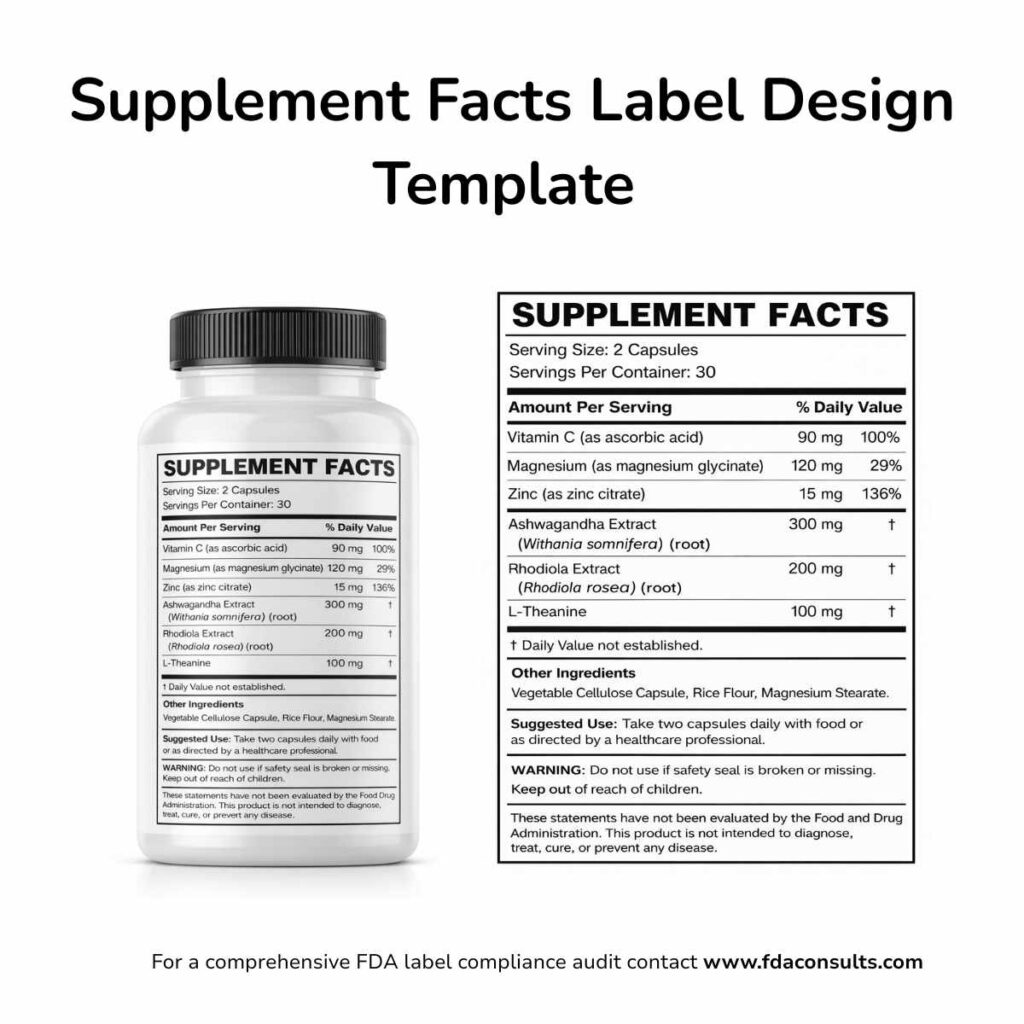
1. “Supplement Facts” vs. “Nutrition Facts”
The first and most fundamental rule of compliance for dietary supplement labeling is correct product classification. If a product is marketed as a dietary supplement, its label must clearly use the heading “Supplement Facts.” This requirement distinguishes supplements from conventional foods, which must instead use the “Nutrition Facts” panel.
Using the wrong panel title is one of the most common and easily identifiable labeling violations. For example, if a vitamin capsule, herbal extract, or amino acid product displays a Nutrition Facts panel instead of Supplement Facts, the product may be considered misbranded under federal law. This seemingly minor mistake frequently results in import detentions at ports of entry or enforcement actions during routine FDA inspections.
Beyond the panel title itself, the two labeling systems differ in several technical ways.
Source Listing
A unique feature of the Supplement Facts panel is the ability to disclose the source of a nutrient or compound. For example, a calcium supplement may list:
Calcium (as calcium carbonate)
This type of source disclosure helps consumers and regulators understand how the active nutrient is derived or formulated. However, this practice is not allowed in standard food Nutrition Facts labels, where ingredients must appear exclusively in the ingredient list.
Because supplements often use specialized chemical forms of nutrients—such as magnesium glycinate, zinc citrate, or methylcobalamin (Vitamin B12)—the ability to disclose the source provides clarity regarding bioavailability and ingredient identity.
Non-RDI Ingredients
Another major distinction involves dietary ingredients that do not have an established Daily Value (DV).
Many supplements contain compounds such as:
- Ashwagandha
- Coenzyme Q10 (CoQ10)
- L-theanine
- Alpha-lipoic acid
- Herbal extracts
These ingredients do not have an FDA established Daily Value. However, they must still appear inside the Supplement Facts panel with their respective quantities. For these ingredients, the % Daily Value column is replaced with a dagger symbol (†) indicating that a Daily Value has not been established.
Conventional food products cannot include such ingredients inside the Nutrition Facts box. Instead, these compounds would have to appear only in the ingredient list, which is why the Supplement Facts panel was specifically designed for the supplement category.
The Botanical Rule
Herbal ingredients introduce additional labeling requirements that are unique to dietary supplements.
When labeling a botanical ingredient, the FDA requires three key elements:
- Latin binomial name (Genus and species)
- Common name of the plant
- Plant part used
For example:
Ashwagandha (Withania somnifera) root extract
or
Green Tea (Camellia sinensis) leaf extract
This rule prevents ambiguity because many plants share common names but differ significantly in their chemical composition and safety profiles. Listing the Latin scientific name and plant part used ensures that the ingredient is clearly identifiable and prevents substitution or adulteration.
Failure to follow this botanical naming convention is a frequent cause of supplement label non-compliance.
2. The 2026 NDI Final Guidance
One of the most important regulatory developments affecting supplement manufacturers in 2026 is the FDA’s updated guidance on New Dietary Ingredients (NDIs).
Under DSHEA, dietary ingredients are divided into two categories: “old” ingredients and “new” ingredients. The regulatory cutoff date for determining this classification is October 15, 1994, the date when DSHEA was enacted.
Any dietary ingredient that was not marketed in the United States prior to this date is considered a New Dietary Ingredient.
The 1994 “Old Ingredient” Cutoff
Ingredients that were widely used in dietary supplements before October 15, 1994—such as vitamin C, ginseng, or fish oil—are generally considered grandfathered ingredients. These ingredients do not require additional FDA notification, provided they are used in a manner consistent with historical use.
However, many modern supplements contain ingredients developed long after 1994, including:
- Novel plant extracts
- Synthetic compounds
- Fermented bioactives
- Engineered peptides or amino acid derivatives
Such ingredients often fall under the NDI classification.
Mandatory NDI Notification
If a dietary ingredient qualifies as an NDI, the manufacturer must submit an NDI Notification to the FDA at least 75 days before the product enters the market. This submission must demonstrate that the ingredient is reasonably expected to be safe under the proposed conditions of use.
An NDI notification typically includes:
- Detailed ingredient identity and manufacturing process
- Historical safety data
- Toxicological information
- Estimated daily intake levels
- Proposed supplement formulation
Without this notification, the FDA may determine that the ingredient is adulterated under the FD&C Act.
2026 Enforcement Changes
In recent years, the FDA has significantly expanded its ability to monitor dietary supplement ingredients through data analytics and automated surveillance tools.
In 2026, the agency is actively using AI-driven ingredient monitoring systems to scan product labels, websites, and import declarations. These systems compare ingredient lists against known databases of pre-1994 dietary ingredients and filed NDI notifications.
If an ingredient appears to be new and no NDI notification exists, the product may be flagged for enforcement action. This can lead to:
- Import alerts
- Shipment detention
- Product seizures
- Warning letters
- Retailer delisting
For supplement brands, verifying the regulatory status of every ingredient before product launch is now a critical step in the compliance process.
3. Mastering Claims & The “Single Disclaimer” Rule
Health-related marketing claims are one of the most sensitive areas of supplement regulation. DSHEA allows dietary supplement manufacturers to make structure/function claims, which describe how a nutrient supports normal body functions. However, these claims must not imply that the product diagnoses, treats, cures, or prevents a disease.
In late 2025, the FDA introduced an important change regarding the placement of the DSHEA disclaimer. Previously, the disclaimer had to appear adjacent to every individual structure/function claim. This often created excessive label clutter, especially for products with multiple benefit statements.
The 2026 Enforcement Discretion
Under updated enforcement discretion, the FDA now allows manufacturers to include one clearly visible DSHEA disclaimer on the label rather than repeating it next to every claim.
However, this single disclaimer must still be:
- Prominent
- Easy to read
- Clearly associated with all structure/function claims on the label
Most brands place the disclaimer either directly below the Supplement Facts panel or near the product description on the label.
Mandatory DSHEA Disclaimer Text
The exact wording of the disclaimer remains unchanged:
“These statements have not been evaluated by the Food and Drug Administration. This product is not intended to diagnose, treat, cure, or prevent any disease.”
This wording cannot be modified or paraphrased. Any alteration may render the disclaimer non-compliant.
Understanding the “Drug Claim” Boundary
Perhaps the most important compliance principle for supplement marketing is the distinction between structure/function claims and drug claims.
Acceptable structure/function claim:
Supports healthy blood sugar levels
Unacceptable drug claim:
Lowers blood sugar or treats diabetes
The latter implies treatment of a disease, which places the product into the category of unapproved drugs. This is one of the most common reasons dietary supplements receive FDA Warning Letters.
Brands must therefore carefully review every marketing statement to ensure that it describes support of normal body functions rather than treatment of medical conditions.
4. Proprietary Blends: Balancing Secrets and Safety
Many supplement companies protect their formulas by using Proprietary Blends within the Supplement Facts panel. A proprietary blend allows the manufacturer to disclose the total weight of a combination of ingredients without revealing the exact amount of each individual ingredient.
However, the FDA still requires several important disclosures to maintain transparency.
Total Blend Weight
The label must clearly list the total milligram weight of the entire proprietary blend.
Example:
Proprietary Herbal Blend — 1,200 mg
This total weight represents the combined amount of all ingredients included in the blend.
Order of Predominance
Even though individual amounts are not disclosed, the ingredients inside the blend must still be listed in descending order of weight.
For example:
Proprietary Herbal Blend (1,200 mg)
Ashwagandha root extract, Rhodiola rosea root extract, Eleuthero root extract
This ordering requirement ensures that consumers and regulators can understand which ingredients are present in the largest quantities.
The (b)(2) Exception
Certain nutrients cannot be hidden inside proprietary blends.
Vitamins and minerals with established Daily Values must be listed individually with their exact quantities.
For example:
Vitamin C — 90 mg (100% DV)
Because Daily Values are tied to recommended nutrient intake levels, hiding these ingredients inside proprietary blends would prevent consumers from understanding how much they are consuming.
5. 2026 Compliance Checklist for Supplement Brands
Before printing supplement labels or launching a product, manufacturers should verify several critical compliance factors.
Facility Registration
Dietary supplement manufacturing facilities must be properly registered with the FDA and maintain current registration status within the biennial cycle. This registration ensures that the FDA can track manufacturing locations and conduct inspections when necessary.
Identity Testing
Current Good Manufacturing Practices (cGMP) require that manufacturers perform identity testing on every raw material used in production. This testing verifies that the ingredient received from suppliers actually matches the declared ingredient and has not been substituted, diluted, or contaminated.
Documentation of identity testing must be maintained as part of the product’s manufacturing records.
Adverse Event Contact Information
Supplement labels must provide a way for consumers to report serious adverse events.
This typically includes either:
- A U.S. mailing address
- A domestic phone number
- A website or electronic reporting system
Providing accessible contact information ensures that safety issues can be reported and evaluated.
Minimum Font Size Requirements
The FDA also specifies minimum type size requirements for supplement labels. The “Supplement Facts” title must be the largest text on the panel, ensuring it is clearly visible to consumers. Most text within the panel must be at least 8-point font, although 6-point font may be permitted for very small packages.
Failure to meet these formatting requirements can cause a label to be considered misbranded even if the content itself is correct.
Precision is Your Best Defense
The dietary supplement industry continues to evolve as the FDA increases enforcement activity and adopts new technologies for monitoring ingredient safety and marketing claims. In 2026, regulators are particularly focused on label clarity, substantiated claims, and accurate ingredient disclosures. Companies that fail to maintain precise labeling standards risk facing regulatory actions that can damage both their reputation and their ability to sell products.
Even a small technical error—such as an incorrect disclaimer placement, an unverified NDI, or a misformatted Supplement Facts panel—can trigger enforcement actions ranging from import detentions to public Warning Letters.
For supplement brands, investing in professional regulatory review and compliant label design is one of the most effective ways to protect long-term market access.
Download our Supplement Facts Master Template or contact FDA Consults for a professional formulation and label audit.