

AYUSH vs. US FDA: Navigating the “Supplement” Label for Indian Ayurveda and Herbal Products
AYUSH vs. US FDA: For thousands of years, Ayurveda has been one of the most respected and enduring systems of wellness in the world. Rooted in natural healing and holistic balance, it has shaped how generations approach health, nutrition, and lifestyle. Today, Ayurveda is no longer limited to India—it has grown into a global industry worth billions of dollars, with strong demand in the United States and other developed markets.
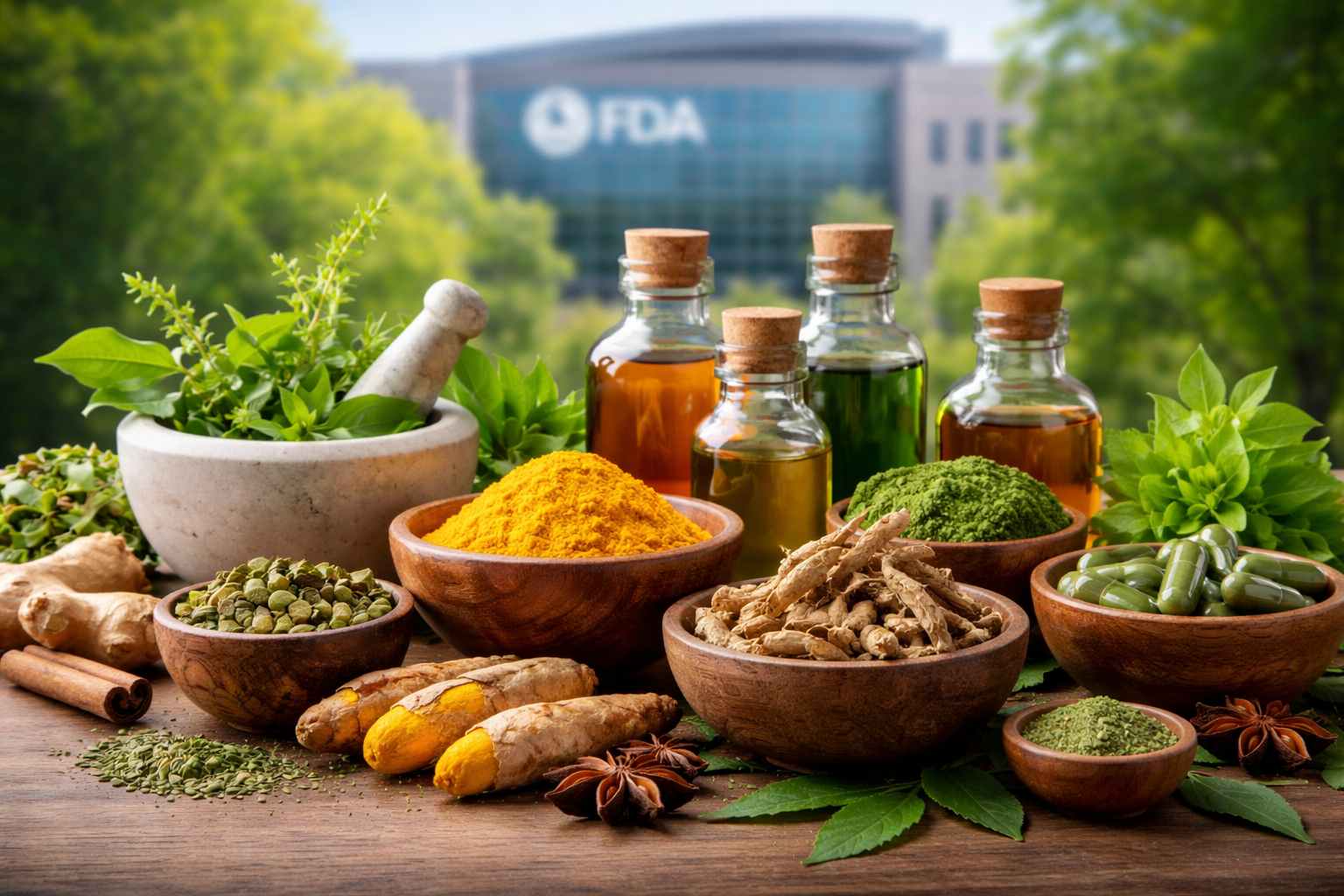
Indian exporters are uniquely positioned to benefit from this demand. Products such as Ashwagandha, turmeric, moringa, Brahmi, and Triphala have become increasingly popular among consumers seeking natural alternatives for everyday wellness. From capsules and powders to oils and herbal blends, Ayurvedic formulations are now widely available across retail stores, eCommerce platforms, and specialty wellness outlets in the U.S.
However, despite this growing opportunity, a significant number of Indian exporters are encountering unexpected challenges. Shipments are being detained at ports, products are being rejected, and in some cases, companies are facing long-term restrictions under FDA import alerts. What makes this particularly frustrating is that many of these products are fully compliant under Indian regulations.
The root of the problem lies in a fundamental misunderstanding. An AYUSH license, while essential for domestic manufacturing and sale in India, is not equivalent to compliance with U.S. FDA regulations. The two systems operate under entirely different legal frameworks, and what is acceptable in one may be considered a violation in the other.
Understanding the Core Difference: AYUSH vs. FDA
In India, the Ministry of AYUSH regulates traditional systems such as Ayurveda, Yoga, Unani, Siddha, and Homeopathy. Under this framework, products are often approved based on classical formulations, traditional knowledge, and long-standing usage. It is common for Ayurvedic products to be marketed with therapeutic intent, including claims related to specific health conditions or diseases.
In contrast, the United States Food and Drug Administration regulates most herbal products as dietary supplements under the Dietary Supplement Health and Education Act (DSHEA). Under this system, supplements are intended to support normal body functions rather than treat or cure diseases. The distinction between a supplement and a drug is not based on the ingredient itself, but on how the product is presented and marketed.
This difference creates a critical legal boundary. In the U.S., a product remains a dietary supplement only if it avoids disease-related claims. The moment a product claims to diagnose, treat, cure, or prevent a disease, it is automatically classified as a drug. This applies regardless of whether the product is natural, traditional, or widely accepted in another country.
This distinction is not theoretical—it is strictly enforced. The FDA evaluates not only the physical product but also its labeling, branding, website content, and even customer testimonials. A product that is perfectly acceptable under AYUSH can quickly fall out of compliance in the U.S. simply because of how it is described.
The FDA Is Not Just Checking Ingredients — It Is Checking Your Claims
In 2026, FDA enforcement has evolved significantly, especially for imported supplements. The agency is no longer focused solely on ingredient safety, contamination levels, or manufacturing practices. While these remain important, the FDA has expanded its attention to how products are communicated to consumers.
Regulators now closely analyze product labels, marketing language, social media promotions, brand names, and even implied therapeutic intent. This means that exporters must think beyond formulation and quality—they must also ensure that every aspect of their product presentation aligns with FDA expectations.
At the center of this enforcement is a clear legal line. If a product claims to cure diabetes, treat arthritis, heal thyroid disorders, or reverse conditions such as PCOS, the FDA will not consider it a supplement. Instead, it will classify it as an unapproved new drug. This classification triggers immediate regulatory action.
The consequences can be severe. Shipments may be seized at the port of entry without further testing. Companies may receive FDA Warning Letters, which are publicly available and can damage brand reputation. In many cases, exporters are placed under Import Alert, resulting in Detention Without Physical Examination, where future shipments are automatically held without inspection.
Over time, these issues can escalate. Retailers and distributors may refuse to carry the product, and online platforms may remove listings. The long-term impact on brand credibility can be significant, making it difficult to re-enter the market even after corrective actions are taken. This misunderstanding around claims remains one of the most common reasons why AYUSH-approved products fail in the U.S. market.
The 2026 NDI Final Guidance: Is Your Ingredient “New”?
Another major regulatory challenge for Ayurvedic exporters involves the concept of a New Dietary Ingredient, or NDI. Under U.S. law, any dietary ingredient that was not marketed in the United States before October 15, 1994, is considered new.
This rule applies not only to unfamiliar herbs but also to modified versions of traditional ingredients. In 2026, the FDA finalized its long-awaited guidance on NDI notification procedures, making enforcement more structured and predictable.
Exporters are now required to submit an NDI Notification at least 75 days before introducing a new ingredient into the U.S. market. This notification must include detailed information about the ingredient’s identity, manufacturing process, safety data, and intended use.
One of the biggest misconceptions among Indian exporters is that traditional use automatically guarantees acceptance. While herbs like Ashwagandha and moringa are widely recognized, certain forms of these ingredients may still be considered new. For example, standardized extracts with high concentrations of active compounds, CO₂-extracted oils, and advanced formulations designed to enhance bioavailability can all trigger NDI requirements.
The FDA evaluates not just the plant itself but how it has been processed. If the extraction method significantly alters the chemical composition, the ingredient may be classified as new, even if it has been used traditionally for centuries. Failure to submit an NDI notification when required can result in shipment detention and refusal. This makes it essential for exporters to evaluate their formulations carefully before entering the U.S. market.
The Claim Conversion Problem: Translating AYUSH Language into FDA Compliance
Perhaps the most significant compliance gap between AYUSH and the FDA lies in how product claims are framed. In India, Ayurvedic products are often marketed for specific conditions, drawing from classical texts and traditional knowledge. In the United States, this approach is not permitted for dietary supplements.
Instead of disease-related claims, the FDA allows what are known as structure/function claims. These describe how a product supports normal body functions without implying treatment or cure.
For example, a product that would traditionally be marketed in India as curing insomnia must instead be described as supporting a healthy sleep cycle. A formulation intended for managing blood pressure should be positioned as helping maintain blood pressure levels within a normal range.
This shift may seem subtle, but it has significant legal implications. Even small wording differences can determine whether a product is classified as a supplement or a drug.
The challenge extends beyond labels. Websites, blogs, advertisements, and customer testimonials must all follow the same rules. A single statement suggesting that a product treats a disease can trigger regulatory action.
Even product names can create compliance risks. Names that directly reference diseases or conditions may be interpreted as claims, leading to enforcement actions. As a result, branding must be carefully designed to align with FDA expectations.
The 2026 “Single Disclaimer” Rule: A Small Change with Big Impact
One of the more practical updates in 2026 relates to how the mandatory DSHEA disclaimer is displayed. This disclaimer, which states that the product has not been evaluated by the FDA and is not intended to diagnose, treat, cure, or prevent any disease, is required whenever structure/function claims are made.
In the past, this disclaimer had to appear alongside every claim, leading to cluttered labels and limited design flexibility. For small packaging formats commonly used in Ayurvedic products, this created significant challenges.
Recognizing this issue, the FDA introduced an enforcement discretion policy in 2026 allowing the use of a single disclaimer, provided it is clearly linked to all claims on the label. This change simplifies label design and allows brands to present their products in a cleaner, more premium format.
For exporters, this is an opportunity to improve packaging while maintaining compliance. It also aligns Ayurvedic products more closely with the aesthetic expectations of the U.S. retail market.
Why AYUSH Products Are Detained?
Beyond labeling and claims, the FDA is increasingly focusing on underlying product safety issues. Two of the most common reasons for detention are unapproved color additives and heavy metal contamination.
Color additives are often overlooked, but they play a significant role in compliance. The FDA has been phasing out certain synthetic dyes, particularly those derived from petroleum. If a product contains a color additive that is not approved for use in the United States, it may be classified as adulterated and detained at the port.
Heavy metals represent an even more critical concern. Under the FDA’s “Closer to Zero” initiative, there is increased scrutiny of toxic elements such as lead, mercury, arsenic, and cadmium. Even when these elements occur naturally in soil, they can still lead to regulatory action if levels exceed acceptable limits.
Products that include mineral-based ingredients or traditional formulations such as bhasma are particularly at risk. Once a facility is associated with heavy metal violations, it may be placed under Import Alert, leading to automatic detention of future shipments.
The Hidden Risk: FSVP and Importer Responsibility
Another important factor that many exporters overlook is the role of the U.S. importer. Under the Foreign Supplier Verification Program (FSVP), the importer is responsible for ensuring that foreign suppliers meet U.S. safety standards.
However, if the importer fails to maintain proper documentation or does not fully understand the product, the shipment may still be detained. This means that even compliant exporters can face issues if their U.S. partners are not properly prepared. Successful entry into the U.S. market requires coordination between exporter and importer, with clear documentation and shared understanding of regulatory requirements.
The Real Cost of Non-Compliance
The impact of non-compliance extends far beyond a single shipment. Financial losses can include product value, storage fees, re-export costs, and legal expenses. Business relationships may be affected, with distributors and retailers becoming hesitant to work with companies that have regulatory issues.
Over time, repeated violations can lead to long-term restrictions, making it difficult to re-enter the market. In some cases, companies may need to rebuild their brand entirely to regain trust.
The Maryland Advantage: Bridging the Gap Between AYUSH and FDA
Navigating FDA regulations requires more than technical knowledge—it requires timely execution, clear communication, and a deep understanding of enforcement trends. Having a presence in the United States can make a significant difference.
Our office in Columbia, Maryland, serves as a bridge between Indian exporters and U.S. regulatory requirements. We help translate Ayurvedic concepts into FDA-compliant language, evaluate whether NDI notifications are required, and review labels and marketing materials for potential risks.
Because of our proximity to the FDA’s White Oak campus, we stay closely aligned with regulatory updates and enforcement practices. This allows us to provide timely guidance and help exporters adapt quickly to changing requirements.
The Opportunity Is Still Massive
The demand for Ayurvedic products in the United States continues to grow, driven by increasing interest in natural and holistic wellness. The opportunity for Indian exporters remains strong, but success requires a clear understanding of the regulatory landscape. Compliance is no longer just about product quality. It is about how the product is presented, documented, and positioned in the market. Companies that invest in proper labeling, claim management, and regulatory alignment will be well positioned to succeed.
Those who rely solely on AYUSH approval as proof of export readiness risk costly detentions and long-term setbacks.
Don’t Let a “Medicinal” Claim End Your American Dream
A single word on a label can determine whether your product succeeds or fails in the U.S. market. Understanding and respecting FDA requirements is essential for long-term growth. If you are planning to export Ayurvedic products to the United States, now is the time to review your compliance strategy.
👉 Book an AYUSH-to-FDA Label Audit
👉 Download our 2026 Supplement Label Template