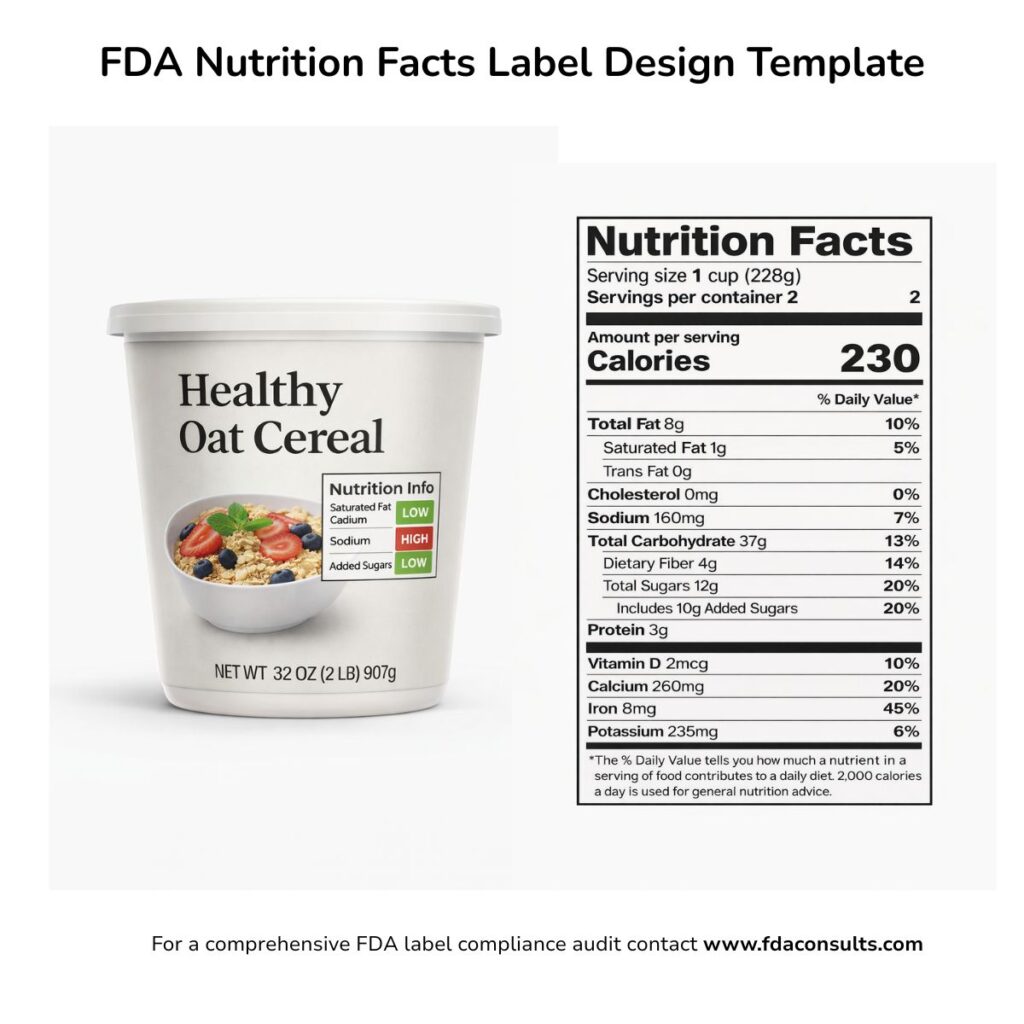
1. The Core Anatomy of a 2026 Nutrition Label
While the standardized layout remains recognizable, the FDA has prioritized specific “Nutrients of Public Health Significance.”
If your label follows the outdated 1990s or early 2010s format, it is considered misbranded.
Mandatory Elements for 2026
The “Big 4” Minerals
You must declare the actual amount and % Daily Value (DV) for:
• Vitamin D
• Calcium
• Iron
• Potassium
Vitamins A and C are now voluntary unless added to the product.
This shift reflects updated dietary deficiency data across U.S. populations.
Added Sugars Indentation
“Added Sugars” must be indented directly below “Total Sugars.” This indentation is not optional formatting — it is a major enforcement focus in 2026 as regulators target metabolic health transparency.
Improper indentation or failure to declare added sugars is one of the most common warning-letter triggers.
Bold Calories Requirement
The calorie declaration must be the largest and boldest element on the Nutrition Facts panel. This ensures “at-a-glance” visibility and aligns with behavioral research supporting calorie awareness.
Updated Mandatory Footnote
The label must include the exact wording:
“The % Daily Value tells you how much a nutrient in a serving of food contributes to a daily diet. 2,000 calories a day is used for general nutrition advice.” Even minor wording deviations may render a label non-compliant.
2. The 2026 Front-of-Package (FOP) Shift
The most significant regulatory shift currently facing the food industry is the proposed Front-of-Package (FOP) Nutrition Labeling rule.
The “Nutrition Info” Box
The FDA is finalizing a mandatory graphic element for the front of most packaged foods.
This FOP box will highlight:
• Saturated Fat
• Sodium
• Added Sugars
Using descriptors such as:
Low
Med
High
This change will move nutritional transparency from the back panel to the primary display panel.
Strategic Reformulation Advantage
Consultant’s Tip:
Manufacturers who reformulate now to reduce sodium, added sugars, or saturated fat will avoid receiving a “High” badge once the rule becomes final. A “High Sodium” or “High Sugar” indicator on the front panel may significantly affect retail buyer decisions and consumer perception.
3. The New 2026 “Healthy” Definition
On February 24, 2026, new regulatory research confirmed that only 14% of currently packaged foods meet the FDA’s updated “Healthy” definition.
If you intend to use the word “Healthy” on your label, you must meet two strict criteria.
Criterion 1: Food Group Equivalent
The product must contain a meaningful amount of a recommended food group, such as:
• 1/2 cup of vegetables
• 3/4 ounce of whole grains
• Equivalent dairy, fruit, or protein portions
Criterion 2: Nutrient Limits
The product must fall below strict limits for:
• Saturated fat
• Sodium
• Added sugars
Market Impact Example
Products no longer allowed to use “Healthy”:
• High-sugar yogurts
• Refined white breads
• Sweetened cereals
Products that automatically qualify:
• Water
• Avocados
• Nuts
Improper use of “Healthy” constitutes a misbranding violation.
4. Serving Sizes: Reality vs. Recommendation
Serving sizes must reflect what Americans actually consume, not what they “should” consume. This is based on Reference Amounts Customarily Consumed (RACC).
Dual-Column Labels
If a package contains between 2 and 3 servings (e.g., pint of ice cream, 24 oz soda), you are likely required to provide a Dual-Column Label.
This displays:
• Per Serving
• Per Package
Failure to include dual-column labeling is a common importer violation.
Single-Serving Rule
Any container reasonably consumed in one sitting (e.g., 20 oz soda) must be labeled as one serving.
Even if this reveals a high calorie or sugar load.
5. Compliance Checklist for Exporters
Before printing large-scale production runs, confirm:
DUNS Number
Do you have your Unique Facility Identifier for 2026 facility registration?
Metric/U.S. Dual Declaration
Net quantity must appear in both metric and U.S. customary units.
Rounding Rules
Calories must be rounded per 21 CFR 101.9 (nearest 5 or 10).
Allergen Disclosure
Sesame must be declared as the 9th major allergen.
Updated Nutrition Panel Format
Ensure proper font sizing and bolding.
Accurate Daily Value Calculations
Verify %DV reflects updated reference values.
6. Uniform Compliance Date: January 1, 2028
The FDA has established that for all food labeling regulations published between January 1, 2025 and December 31, 2026, the Uniform Compliance Date is January 1, 2028.
This creates a transition window.
Strategic Advantage
You may use existing compliant inventory during the grace period.
However:
New products introduced in 2026 should follow updated standards immediately to avoid costly redesigns.
Delaying updates often results in double-printing costs and import delays.
7. Required Formatting Rules
• “Calories” must be largest and boldest text
• “Added Sugars” must be indented under Total Sugars
• %DV must align vertically
• The footnote must appear exactly as written
• The line thickness must follow FDA specifications
• Font must be FDA-approved condensed style equivalent
8. Why Food Labels Trigger Import Alerts
In the 2026 enforcement climate, small errors cause large consequences.
Common triggers include:
• Improper rounding of calories
• Incorrect serving size determination
• Misplaced Added Sugars line
• Failure to declare Sesame allergen
• Incorrect dual-column formatting
• Inaccurate %DV calculations
Even one formatting error can place a company on an Import Alert “Red List,” stopping all future shipments.
Why a Label Audit Is Your Best Insurance
In the MAHA regulatory era, food labeling is no longer a compliance checkbox — it is a market access requirement.
A comprehensive label audit ensures:
• Technical accuracy
• Regulatory defensibility
• Smooth customs clearance
• Retail acceptance
Ready to secure your U.S. market entry?
Download our Free Nutrition Facts Master Template
or contact FDA Consults for a comprehensive 2026 Label Audit.