

How to Export Coffee from Brazil to the USA: A Step-by-Step SME Operations & FDA Compliance Guide
Brazil is the undisputed global powerhouse of coffee production, anchoring nearly 40% of the world’s supply. For small and medium-sized enterprises (SMEs)—including independent family estates in Minas Gerais, regional boutique cooperatives in São Paulo, and specialty roasters in Espírito Santo—the United States represents the most lucrative consumer market in the world.
However, many first-time Brazilian exporters believe that executing a successful shipment to the U.S. is purely a logistical challenge of securing ocean freight containers at the Port of Santos. In reality, the physical transit is the straightforward part. The true barrier to entry is the regulatory gatekeeper: the United States Food and Drug Administration (FDA).
Under the Food Safety Modernization Act (FSMA), the FDA treats imported coffee as a regulated human food product. Whether you are shipping 20 tons of raw green arabica beans in bulk sisal sacks or a single pallet of premium, retail-ready roasted specialty blends, your business must cross strict federal regulatory thresholds. Failing to align your Brazilian operational paperwork with precise FDA matching codes will result in your cargo being flagged by automated port screeners, locked in a customs bonded warehouse, or hit with a costly Administrative Detention.
This comprehensive, highly educational operational guide provides small-to-medium Brazilian coffee producers with an absolute blueprint on how to export coffee from Brazil to the USA safely, legally, and profitably.
1. Understanding the U.S. Regulatory Landscape for Coffee Imports
When your coffee shipment arrives at a U.S. port of entry (such as Miami, New York, or Long Beach), it is scrutinized by three independent federal agencies, each governing a distinct aspect of the cargo. To prevent border rejections, an SME exporter must understand how these agencies overlap.
| 🛃 1. US Customs (CBP | 🩺 2. US FDA | 🌱 3. USDA APHIS |
|---|---|---|
| • Importer Bonds | • Facility Registration | Plant Health Protection |
| • Tariff Codes (HTS) | • Prior Notice | Pest Inspection |
| • Origin Markings | • FSVP Supplier Law | • No PPQ 587 Needed |
U.S. Customs and Border Protection (CBP)
CBP manages the financial and legal entry of the goods into the United States. They collect customs entry forms, verify your domestic importer’s customs bond, assess processing fees, and ensure the physical cargo matches the shipping manifests.
U.S. Food and Drug Administration (FDA)
The FDA governs the safety, purity, and tracking of anything Americans consume. The FDA does not issue import “permits” for coffee; instead, it enforces mandatory, system-wide transparency through Foreign Food Facility Registrations and pre-arrival electronic alerts known as Prior Notices. The FDA has the legal authority to sample your beans for molds, mycotoxins, or illegal pesticide residues.
United States Department of Agriculture (USDA)
The USDA’s Animal and Plant Health Inspection Service (APHIS) checks plant materials to ensure invasive pests do not enter the U.S. ecosystem.
⚠️ Critical Regulatory Relief for Green Beans: Per official USDA APHIS directives, raw green unroasted coffee beans do not require a USDA PPQ 587 plant import permit from any country of origin, including Brazil. However, they are still subject to visual inspection at the first U.S. port of entry. If port inspectors discover active wood-boring beetles, live insects, or unauthorized agricultural soil in the container, the USDA will order the container to be instantly quarantined, fumigated at your expense, or destroyed.
2. Navigating the Logistics Chain: From Farm to Port
Before a single sack of coffee is loaded onto an ocean vessel, a Brazilian SME must navigate the local administrative export frameworks. Brazil manages its outbound trade via the unified SISCOMEX (Integrated Foreign Trade System) platform.
Step 1: Secure Your RADAR License
In Brazil, no commercial entity can legally export goods without an active RADAR license (Ambiente de Registro e Rastreamento da Atuação dos Interrogantes do Comércio Exterior). Issued by the Receita Federal (Brazilian Federal Revenue), this license authorizes your company to utilize the SISCOMEX network. For small businesses, the “Limited” (Limitada) RADAR tier is typically sufficient, allowing up to $50,000 in exports every six months. As your volume scales, you can request an upgrade to the “Unlimited” (Ilimitada) tier.
Step 2: Formulate the DU-E (Declaração Única de Exportação)
The DU-E is the core digital document within SISCOMEX that replaces old, fragmented export declarations. It links directly to your electronic fiscal invoices (Nota Fiscal Eletrônica). Your local customs broker in Brazil must file the DU-E before your coffee clears Brazilian customs checkpoint controls at the port of departure.
Step 3: Secure the International Coffee Organization (ICO) Certificate of Origin
The ICO mandates that every international movement of coffee must carry a valid ICO Certificate of Origin. In Brazil, this document is officially issued by the Conselho dos Exportadores de Café do Brasil (Cecafé) or local authorized regional trade associations.
The ICO certificate displays your specific exporter identification code, the crop year, the date of shipment, the exact botanical variety (Arabica or Robusta), and the processing method (e.g., Natural, Pulped Natural, or Washed). American customs brokers must have access to this certificate number to finalize the entry paperwork into the United States.
3. FDA Foreign Facility Registration: The Non-Negotiable Step
If your business fails this step, your coffee export operation terminates instantly at the U.S. border. Under the Bioterrorism Act and FSMA provisions, any foreign facility that manufactures, processes, packs, or holds food for consumption in the United States must register with the FDA.
Who Must Register (and Who is Exempt)?
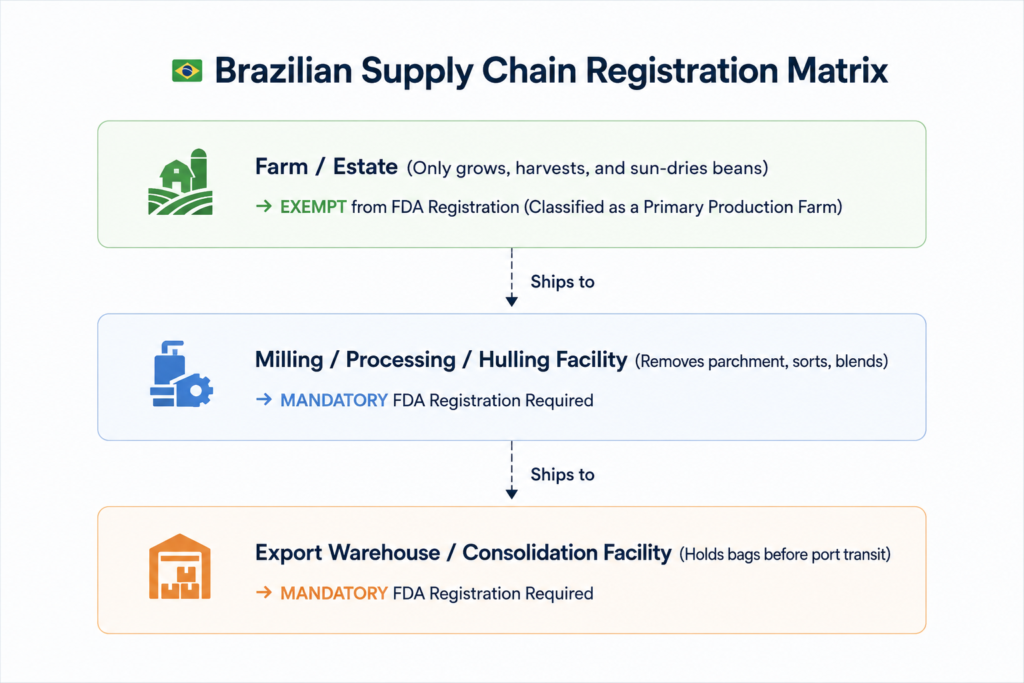
The FDA draws a strict distinction between a “Farm” and a “Processing Facility”:
- The Primary Production Farm: If your Brazilian estate only grows, harvests, and sun-dries coffee cherries on a patio, it fits the FDA’s definition of a primary farm and is exempt from registration.
- The Processing/Milling Facility: The moment coffee beans move to a dry mill (beneficiamento) where they are machine-hulled, polished, graded, mechanically sorted, or blended, that mill is legally classified as a processing facility. It must have a valid FDA Foreign Food Facility Registration.
- The Storage Warehouse: If you store your packed sisal sacks or grainpro bags in an independent export consolidation warehouse near the Port of Santos or Port of Rio de Janeiro, that warehouse must also hold an active FDA registration because it is “holding” food destined for the U.S.
The Critical Data Link: DUNS Number Alignment
When you apply for an FDA registration number via the electronic FDA Industry Systems (FFRM) portal, the FDA will automatically cross-reference your submission against the global Data Universal Numbering System (DUNS) database managed by Dun & Bradstreet.
The primary cause of registration failures for Brazilian small businesses is a character-level data mismatch.
🚨 The Character-Level Rejection Trap
| DUNS Profile: | Café Belo Horizonte LTDA Avenida Paulista, 1000, 4º Andar São Paulo, SP, 01311-200 |
| FDA Profile: | Cafe Belo Horizonte Limited Av. Paulista, 1000 - Fl 4 Sao Paulo, 01311-200 |
| ⚠️ RESULT: | AUTOMATIC REJECTION Googlebot & FDA validators flag a fatal data mismatch |
Your Brazilian corporate registration name, physical address, phone numbers, and zip codes inside your FDA portal application must match your global DUNS profile exactly, character for character. Abbreviations like changing “Avenida” to “Av.” or “LTDA” to “Limited” will cause the automated validation algorithms to reject your application, rendering your registration invalid.
The Biennial Renewal Window
An FDA registration is not a permanent asset. All food facility registrations must be renewed between October 1 and December 31 of every even-numbered year. For example, if you register your facility, your registration must be formally renewed during the winter biennial window. If you miss this window, the FDA systematically purges its database, deleting your number. If you ship coffee under a deleted or inactive registration code, your container will be held at the U.S. port of entry as an illegal entry.
4. Appointing a Verified U.S. Agent
A foreign manufacturer cannot complete their mandatory FDA registration without officially designating a U.S. Agent. This is a non-negotiable legal requirement under U.S. federal law.
The Legal Role of a U.S. Agent
Your U.S. Agent must be a physical person or a registered domestic entity physically located inside the United States. They act as the primary operational bridge between your Brazilian production facility and the FDA.
The FDA utilizes this agent to communicate inspection schedules, verify shipment documentation data, and deliver urgent regulatory notifications. If the FDA has an emergency question regarding an incoming coffee container at 2:00 AM at the Port of New York, they will call your U.S. Agent.
Why Remote or Cheap Digital Agents are a Business Risk
Many small exporters attempt to save money by purchasing cheap, automated “digital-only” U.S. Agent listings or utilizing the name of an overseas cousin who lives in America. This creates an extreme operational liability.
If the FDA attempts to contact your designated U.S. Agent and that agent fails to respond in a timely, professional window, the FDA has the full authority to immediately revoke your foreign facility registration and block your incoming ocean containers.
Your U.S. Agent should be a specialized, professional regulatory consultancy based within close proximity to federal decision-makers. Having a dedicated partner based in the Maryland/Washington D.C. corridor, operating just miles from the FDA’s White Oak Headquarters, ensures that your firm is represented with absolute professional authority. We speak the technical language of border screeners, allowing you to bypass unexpected logistical gridlocks before they spiral into permanent supply chain disasters.
5. Filing FDA Prior Notice: Timing and Technical Specifications
Every single commercial food shipment entering the United States must receive an official clearance code known as an FDA Prior Notice Confirmation Number. This notification alerts the FDA exactly what food is arriving, where it was manufactured, who is importing it, and what vehicle is moving it, allowing automated security filters to assess risk profiles before the hull enters American jurisdiction.
Strict Prior Notice Submission Timelines
Prior Notice must be submitted electronically via the CBP Automated Commercial Environment (ACE) network or the FDA Prior Notice System Interface (PNSI). The submission windows are governed by strict federal laws based entirely on the physical mode of transportation moving your coffee:
Mode of Transport Mandatory Minimum Submission Deadline Before Arrival
🚢 Ocean Freight: Vessel Minimum 8 hours before the ship docks at the U.S. port.
✈️ Air Cargo: Minimum 4 hours before the aircraft touches down in the U.S.
🚊 International Rail: Minimum 2 hours before the train crosses the U.S. border.
🚚 Express Courier / Land: Minimum 2 hours before the vehicle hits the port of entry.
💡 The 48-Hour Industry Best Practice: While federal law states 8 hours for ocean freight, specialized customs brokers universally recommend submitting your Prior Notice 48 hours before the ship leaves the foreign port, concurrent with your mandatory Importer Security Filing (ISF 10+2). This gives your customs team an open cushion to correct data errors before the vessel crosses international waters.
6. HTS Classification and Customs Valuation for Coffee Shipments
To clear U.S. customs cleanly and pay appropriate federal filing fees, your documentation must use the precise 10-digit Harmonized Tariff Schedule (HTS) code assigned to your specific variation of coffee.
The Standard Coffee HTS Codes
Virtually all forms of coffee fall under the 0901 heading of the tariff schedule. The most common codes utilized by Brazilian exporters include:
HTS 0901.11.0000: Coffee, not roasted, not decaffeinated (Standard raw green Arabica/Robusta beans).
HTS 0901.12.0000: Coffee, not roasted, decaffeinated.
HTS 0901.21.0000: Coffee, roasted, not decaffeinated (Whole bean or ground consumer packs).
HTS 0901.22.0000: Coffee, roasted, decaffeinated.
Customs Duties and Processing Fees
The good news for Brazilian SMEs is that all primary HTS coffee classifications enter the United States completely duty-free (0.0% Import Tariff).
📡 BOUTIQUE REGULATORY RADAR: While standard import duties on coffee remain at zero, every commercial importer must pay federal user fees calculated as a percentage of your overall commercial invoice value. These caps and limits are adjusted annually by CBP on October 1st to match domestic inflation parameters under the FAST Act framework. Always verify the current fiscal year limits before routing formal customs entries.
Every formal commercial import entry requires the calculation of two distinct federal user fees:
- Merchandise Processing Fee (MPF): Collected by CBP for processing formal entries. The MPF is calculated as a fixed, minor percentage of your cargo’s overall declared value (excluding foreign duty, freight, and insurance costs). CBP enforces a hard-coded regulatory floor and ceiling—meaning there is a mandatory minimum baseline fee assessed per single entry, and an absolute maximum fee cap. Filing your documentation electronically via the Automated Commercial Environment (ACE) system avoids manual processing surcharges.
- Harbor Maintenance Fee (HMF): If your coffee arrives in the United States via an ocean freight container vessel, you must pay an additional HMF calculated as a direct percentage of the cargo value to support U.S. port infrastructure. Unlike the MPF, the HMF features no minimum or maximum caps; it scales directly and infinitely with the total value of your shipment.
7. Packaging, Labeling, and AAFCO/FDA Compliance
The way you pack and label your coffee depends entirely on whether you are shipping bulk commercial raw materials or retail-ready consumer goods.
Bulk Green Bean Shipments (Commercial Processing Sacks)
If you are exporting green coffee beans in traditional 60kg sisal bags or vacuum-sealed protective liner bags inside cardboard crates, you do not need a nutrition panel. However, you must satisfy federal Country of Origin Marking laws:
- Every single bag must be permanently, clearly, and indelibly stenciled or printed with the English phrase: “MADE IN BRAZIL” or “PRODUCT OF BRAZIL”.
- This marking must be placed in a highly visible, readable location on the exterior face of the bag. Stickers or loose paper tags that can easily detach during ocean transit are illegal and can lead to entire containers being held for mandatory re-marking at the port.
Retail-Ready Roasted Coffee (Direct Consumer Packaging)
If your Brazilian business is shipping pre-packaged, roasted ground coffee or retail-wrapped whole beans targeted directly at American grocery shelves or e-commerce buyers, your packaging must feature a fully compliant FDA Consumer Label. This label must include:
- The Identity of the Product: A clear, common name printed on the Principal Display Panel (e.g., “100% Arabica Roasted Whole Bean Coffee”).
- The Net Quantity of Contents: Must be printed in the lower third of the display panel, written in English units (Ounces/Pounds) alongside metric measurements (Grams) (e.g., “Net Wt. 12 oz (340g)”).
- The Ingredient Statement: Whole or ground coffee is a single-ingredient product, but if you add natural hazelnut flavorings or chocolate extracts, every ingredient and potential allergen must be fully declared by its common name in English.
- The Name and Address of the Manufacturer: Must show the physical street address, state, country, and zip code of your Brazilian production mill or include a clear designation of your U.S. distributor (e.g., “Distributed exclusively by [U.S. Enterprise Name]”).
- The Nutrition Facts Panel: Under FDA food formatting metrics, pure, unflavored black coffee contains no significant amounts of macro-nutrients (calories, fats, proteins, or carbohydrates). If your product is pure black coffee, it qualifies for an explicit exemption from printing a full nutrition facts grid, provided the package makes absolutely no health or functional claims (e.g., no “High Antioxidant” or “Energy Boosting” callouts). If you make any nutritional claims, a full, compliant FDA format nutrition facts panel becomes legally mandatory.
8. Navigating the FSMA 204 Traceability Framework
Signed into law to protect public safety, the FDA’s Food Safety Modernization Act (FSMA) Section 204 introduces strict, lot-level digital traceability demands across the international supply chain.
Does FSMA 204 Apply to Coffee?
The answer is a nuanced operational matrix:
- The Exemption for Whole Coffee Beans: The FDA maintains a specific Food Traceability List (FTL) tracking high-risk foods prone to widespread pathogen contamination. Pure whole coffee beans (both green and roasted) are currently excluded from the strict FTL lot-tracking spreadsheet mandate. This means a Brazilian coffee mill does not have to hand over a 24-hour electronic sortable spreadsheet to tracking agents detailing every tracking event.
- The Catch for Flavored or Processed Ready-to-Drink Blends: If your facility expands into manufacturing ready-to-drink canned iced coffees, protein-infused coffee beverages, or processed mixes containing milk, dairy derivatives, or fresh botanicals, those secondary ingredients are governed by FSMA 204 parameters.
Proactive Supply Chain Tracking as a B2B Sales Engine
Even though whole coffee beans are exempt from the formal FTL spreadsheet law, large-scale U.S. grocery buyers (like Whole Foods, Trader Joe’s, or mass-market corporate importers) now demand comprehensive, lot-level digital provenance records from their suppliers.
A smart Brazilian SME should proactively map their processing milestones into clear digital tracking files. For every batch of coffee shipped out of your mill, you should document:
- The Harvesting Trace: The names and locations of the regional farms where the cherries were harvested.
- The Milling Event: The date, time, and specific equipment lot code utilized during hulling and sorting.
- The Packaging Records: The exact tracking number of the GrainPro or shipping containers used to seal the lot.
Providing this clean data directly to your American buyers transforms a routine compliance obligation into a massive commercial competitive advantage, establishing your brand as an elite, low-risk supplier.
9. Quality Control: Mitigating Pathogen and Contamination Risks
When your coffee vessel docks, the FDA’s automated border evaluation system (PREDICT) reviews your shipment’s risk profile. If your facility is new, or if your region has a history of agricultural storage issues, the FDA will order a physical sample of your container.
To clear this screening without an administrative holding order, your processing mill must implement strict, proactive Current Good Manufacturing Practices (cGMPs) to eliminate three primary agricultural hazards:
1. Ochratoxin A (OTA) and Toxic Molds
Ochratoxin A is a dangerous mycotoxin produced by Aspergillus and Penicillium molds when coffee cherries are harvested with high dirt contact or stored with elevated moisture. The FDA treats OTA as a hazardous food adulterant.
The Prevention Fix: Your mill must strictly monitor moisture levels before bagging. Raw green coffee beans should be uniformly dried to a stable water content level between 11% and 12%. Anything higher creates a micro-climate inside a closed ocean container, triggering rapid mold spikes during the hot equatorial voyage from Santos to the United States.
2. Insect Filth and Macro-Contaminants
Under the FDA’s Defect Action Levels framework, the agency will flag and seize any food cargo containing internal insect defects, animal filth, or structural debris (like stones or twigs from the harvest floor).
The Prevention Fix: Ensure your dry mill utilizes high-density optical sorters, vibrating screens, and magnetic separators to pull out macro-debris. Never re-use old, contaminated sisal sacks that have been exposed to rodent nesting areas or insect-prone storage environments.
3. Unauthorized Pesticide Residues
The United States enforces strict, zero-tolerance thresholds for chemical pesticide compounds that are not explicitly approved by the U.S. Environmental Protection Agency (EPA) for coffee crops. Even if a chemical is completely legal to use inside Brazil under local agricultural guidelines, if an FDA laboratory analysis discovers a single trace parts-per-million fraction of that unapproved compound on your beans, the entire shipment will be instantly barred from entry.
The Prevention Fix: Implement strict chemical application tracking on your partner farms. Never utilize off-brand, unverified fertilizers or storage fumigants near your packing lines. Request independent laboratory chemical residue screenings on sample lots before booking your ocean freight.
👉 Connect with a U.S. Compliance Consultant Today