

FSMA 204: The 24-Hour Electronic Traceability Rule for High-Risk Food Exporters
The landscape of international food logistics entering the United States has entered an era of hyper-traceability. Under Section 204 of the FDA Food Safety Modernization Act (FSMA 204), the U.S. Food and Drug Administration has transitioned from a reactive inspection system to an automated, data-driven prevention model. For international food manufacturers, agricultural processors, and customs brokers exporting to the U.S., complying with FSMA 204 is no longer a long-term goal—it is an immediate border-entry requirement.
While the FDA has established a final compliance enforcement deadline of July 20, 2028, regulatory authorities have explicitly stated that routine inspections will prioritize tracking facility data collection structures well ahead of time. Waiting until the absolute deadline to format your compliance network is a recipe for catastrophic supply chain disruption.
Understanding the Scope: Does FSMA 204 Apply to Your Facility?
The enhanced recordkeeping requirements mandated by FSMA 204 do not apply universally to every food item. Instead, they are strictly enforced for any entity that manufactures, processes, packs, or holds commodities officially designated on the FDA’s Food Traceability List (FTL). If your facility exports any of the following high-risk foods, or manufactures multi-ingredient products containing them as raw materials, you are legally subject to the rule:
- Spices & Fresh Herbs: Including high-demand international exports like turmeric, black pepper, cumin, basil, and cilantro.
- Nut Butters: Including shelf-stable, refrigerated, or frozen variations of peanut, almond, cashew, and coconut butters.
- Fresh Produce & Crop Categories: Including tropical tree fruits (mango, papaya, guava, lychee), fresh cucumbers, tomatoes, peppers, melons, and sprouts.
- Leafy Greens: Fresh or fresh-cut variations of arugula, spinach, Romaine, kale, chard, and baby leaf blends.
- Seafood & Aquaculture: Finfish (including histamine-producing and ciguatoxin-associated species), smoked fish, crustaceans (shrimp, lobster, crab), and bivalve mollusks.
The Core Mandate: The 24-Hour Digital Turnaround
The defining characteristic of FSMA Rule 204 is the 24-Hour Response Mandate. If the FDA suspects a foodborne illness outbreak or executes a safety audit, your facility must produce structured traceability data almost instantly.
⚠️ The Regulatory Threshold: Upon an official request from the FDA, a covered facility must provide required traceability records within 24 hours, or within an alternative timeframe agreed to by the agency. Most critically, the FDA mandates that this data be delivered in an electronic sortable spreadsheet (such as an XML or CSV file format).
If your facility relies on disconnected, manual paperwork, physical clipboards, or flat PDF files, meeting this turnaround time is virtually impossible. A failure to produce a sortable file within the designated window is classified as a prohibited act, which can result in immediate shipment detention, import alerts, or an automatic revocation of your facility registration.
The 2028 FDA Extension vs. The Retail Reality
There is a dangerous misconception spreading among international food processing executives. Following intensive industry pushback regarding supply chain readiness, the FDA officially shifted the federal compliance enforcement deadline from its original target to July 20, 2028. Furthermore, Congress formalized this timeline through the Continuing Appropriations Act, directing the agency not to impose penalties prior to that date.
However, treating this delay as a reason to pause your compliance planning is a catastrophic business mistake for two undeniable reasons:
- Mass Retail Enforcement Is Already Active: Major U.S. megachains, foodservice distributors, and big-box buyers built their enterprise resource planning (ERP) architectures around the original timeline. They are not rolling back their data requirements. If you supply these networks, you are likely already seeing vendor scorecard penalties, margin chargebacks, and automated shipment rejections if your inbound logistics lack the mandatory digital traceability markers.
- Supply Chain Data Integration Takes Months: FSMA 204 requires unbroken, systemic data synchronization across multiple international trading partners, customs brokers, and maritime freight forwarders. Upgrading a facility’s software, training quality assurance teams, and running data-transmission stress tests takes anywhere from 12 to 18 months of active deployment.
The Operational Blueprint: CTEs and KDEs
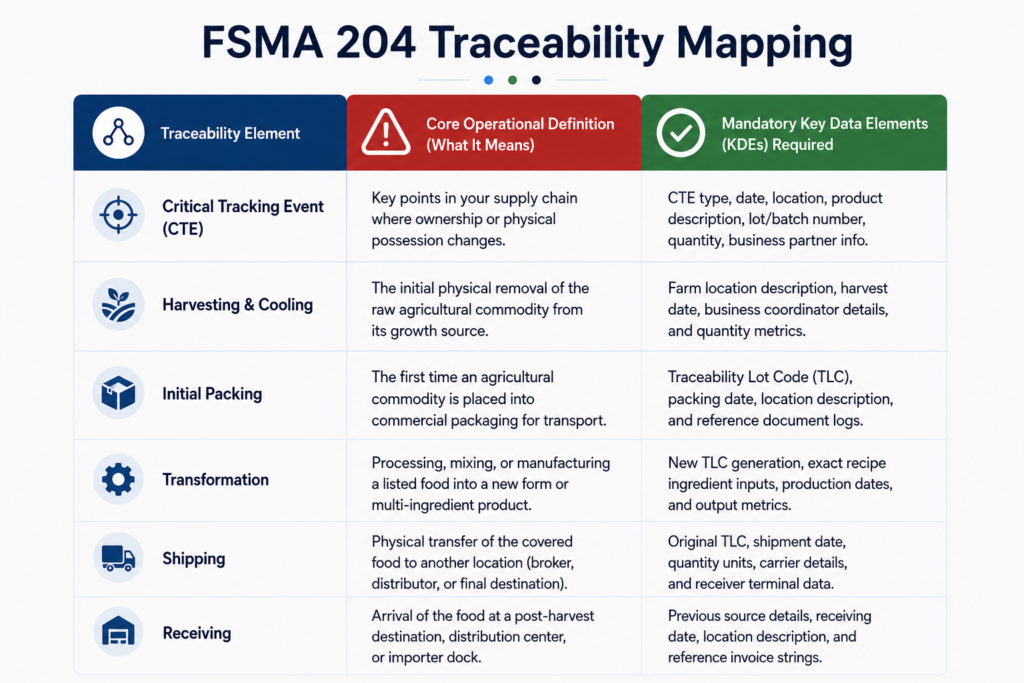
To satisfy the data expectations of FSMA 204, a facility must master two technical concepts: Critical Tracking Events (CTEs) and Key Data Elements (KDEs). A facility must record specific pieces of data (KDEs) at every major logistical point the product passes through (CTEs). This data chain must stay unbroken as the product crosses international borders.
The 3 Core Pillars of a Compliant “Traceability Plan”
Every enterprise exporting high-risk commodities to the U.S. must maintain a formal, written Traceability Plan. During a routine facility inspection, this plan is the very first document an investigator will request. Your plan must explicitly detail three operational components:
1. Description of Recordkeeping Procedures
You must document exactly where your data is captured, how it is stored securely, and what automated software infrastructure or EDI systems your business utilizes to guarantee that data remains completely safe from alteration.
2. Traceability Lot Code (TLC) Methodology
Your plan must outline the precise mathematical or alphanumeric logic your facility uses to generate and assign unique Traceability Lot Codes. You must explain how these lot codes are physically attached to packaging and how they remain linked to digital shipping records as they pass down the line.
3. Physical Supply Chain Mapping
For farms and agricultural operations, your plan must include a detailed geographic map or coordinate structure showing exactly where the food was grown and harvested. This allows compliance officials to trace a contaminated batch right back to its exact patch of soil or water grid.
The Strategic Advantage: Why proximity to Maryland Matters
Navigating a high-stakes, data-driven framework like FSMA 204 requires a balance of advanced technical engineering and real-time regulatory advocacy. When a shipment of high-risk items like spices or seafood faces an unexpected customs query at a U.S. port of entry, time is your greatest threat. Our facility in Columbia, Maryland, sits less than 30 miles from the FDA’s master White Oak headquarters. This strategic geographic proximity gives our consulting desk a massive operational edge:
- Real-Time Crisis Resolution: When a port inspector flags a “Prior Notice” entry or data synchronization issue at 4:30 PM EST, it is the middle of the night for international manufacturing teams. Being domestic allows our compliance experts to step in immediately, communicating directly with customs brokers and FDA compliance officers to resolve data tracking issues before the container is pushed to a costly inspection warehouse.
- Up-to-Date Policy Forecasting: The execution of FSMA 204 is continuously evolving through updated guidance, technical clarifications, and localized enforcement criteria. Operating near the epicenter of federal regulatory development allows us to analyze shifts in enforcement strategies before they disrupt global logistics networks.
- On-Demand Mock Audits: We assist global facilities in running simulated “24-hour data requests,” ensuring your team can generate a clean, sortable electronic spreadsheet under intense pressure without risking a real-world compliance failure.
Act Now: Protect Your Global Supply Chain Corridor
Waiting for a regulatory deadline to hit before upgrading your data structures is an incredibly expensive approach to business. Major multinational U.S. retailers are already adjusting their vendor purchasing guidelines to require strict FSMA 204 data compatibility as a baseline condition for doing business.
Don’t risk having your shipments stopped at the border due to a formatting error or an unverified Traceability Lot Code. Partner with a dedicated team equipped with the localized, professional insights required to protect your market access.