

How to Export Pet Food from Mexico to the United States
The United States pet food market has grown into a multi-billion dollar juggernaut, driven by premiumization, humanization of pets, and a surging demand for specialized veterinary diets, raw treats, and holistic formulations. For agricultural and animal feed manufacturers across Mexico, this massive appetite for premium pet products presents an unparalleled export opportunity. Geographically advantaged by shared logistics corridors, Mexican pet food manufacturers are ideally positioned to serve the U.S. consumer.
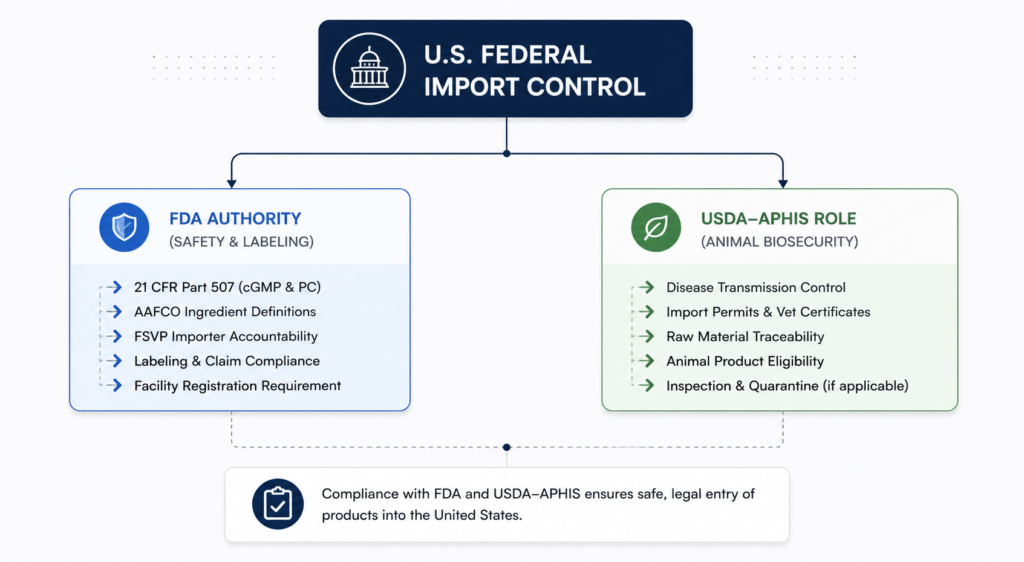
However, moving dog food, cat food, or animal treats across the border involves navigating a complex web of regulatory frameworks. The process extends far beyond a routine customs entry. Because pet food impacts both animal health and the broader agricultural supply chain, it is heavily regulated by multiple federal entities, including the Food and Drug Administration (FDA), the United States Department of Agriculture (USDA) through its Animal and Plant Health Inspection Service (APHIS), and U.S. Customs and Border Protection (CBP). Furthermore, under the Food Safety Modernization Act (FSMA), U.S. importers carry strict legal liabilities for the safety of foreign products.
Failing to meet these interlocking requirements results in costly supply chain disruptions, cargo detentions at the port of entry, product refusals, and irreversible damage to brand reputation. This comprehensive, 2026-updated guide breaks down the exact regulatory blueprint required to successfully export pet food from Mexico to the United States.
Why Pet Food is Regulated Differently than Human Food?
A common and highly risky misconception among Mexican food exporters is that pet food follows the exact same compliance pathway as human food. While both frameworks fall under the broad jurisdiction of the FDA, the statutory requirements, hazard parameters, and labeling standards for animal feed diverge significantly from human products.
1. Distinct Hazard Parameters
In human food, biological controls focus heavily on pathogens like Listeria monocytogenes or E. coli variants specific to human digestion. In animal food safety, the FDA zeroes in on specific serotypes of Salmonella that can cause severe illness in domestic pets or the humans handling the pet food. Because dry kibble and pet treats are touched by pet owners in residential kitchens, a contaminated bag of dog food represents a direct human health hazard, triggering immediate, high-priority federal enforcement.
2. Ingredient Approvals and Definitions
Unlike human food ingredients, which lean heavily on the Generally Recognized as Safe (GRAS) pathway, animal feed ingredients are strictly scrutinized. They must either be formally approved food additives or match the explicit definitions established by the Association of American Feed Control Officials (AAFCO). An ingredient commonly permitted in Mexico may be entirely unauthorized for use in animal feed within the United States.
3. Veterinary Health Claims
The boundary between a food and a drug is heavily policed in the animal sector. Structure-and-function claims designed to attract premium buyers must be executed with extreme care. Broad therapeutic claims can instantly cause a product to be legally classified as an unapproved animal drug, leading to immediate import refusal.
4. Animal By-Product Interception
Because pet food frequently utilizes animal by-products (meat meals, fats, digests, organs), it presents a potential pathway for foreign animal diseases. This risk brings USDA-APHIS into the enforcement loop. Their primary mission is to protect U.S. livestock from catastrophic outbreaks like Bovine Spongiform Encephalopathy (BSE) and Avian Influenza. Consequently, animal-derived ingredients must undergo rigorous source verification and heat-treatment certification before crossing the border.
Step 1: FDA Food Facility Registration for Mexican Manufacturers
The baseline legal requirement for any Mexican business intending to ship pet food into the United States is holding a valid, active FDA Food Facility Registration (FFR). Under the Public Health Security and Bioterrorism Preparedness and Response Act of 2002, the FDA requires all foreign facilities that manufacture, process, pack, or hold animal food for consumption in the U.S. to register their physical infrastructure.
Who Must Register?
Registration is mandatory for the specific physical facility where the manufacturing or processing occurs. If your business operates a slaughterhouse or processing plant in Nuevo León, a blending facility in Jalisco, and a dedicated packaging warehouse in Tamaulipas, each distinct location requires its own individual registration number. Purely administrative offices do not register, but any facility that handles physical product destined for the U.S. must be logged in the system.
The Unique Facility Identifier (UFI) Mandate
The FDA will not finalize or renew a facility registration unless the submitter provides a verified Unique Facility Identifier (UFI). Currently, the only UFI system recognized by the FDA is the Data Universal Numbering System (DUNS) number, managed by Dun & Bradstreet (D&B).
This requirement causes significant delays for Mexican companies. The legal name, physical address, and corporate structure registered with D&B in Mexico must match the details provided in the FDA Industry Systems account down to the character. Discrepancies in spacing, abbreviations (such as S.A. de C.V. versus SA de CV), or postal codes will cause an automated system rejection or trigger a manual review cycle that stalls your export operations.
Biennial Renewal Windows
An FDA facility registration is not a one-time setup. Foreign facilities must renew their registrations between October 1 and December 31 of every even-numbered year (e.g., Q4 2026, Q4 2028). Failing to submit this electronic renewal within the statutory window results in the immediate deactivation of the facility registration code.
If a Mexican supplier attempts to dispatch a freight shipment with a canceled or deactivated registration number, the automated U.S. Customs and Border Protection system will stop the shipment at the border, leading to secure storage holds, demurrage fees, and forced return-to-origin procedures.
⚠️ Critical Regulatory Warning: A common, costly error is assuming that securing an FDA registration number represents an official regulatory approval or a safety endorsement of your product line. An FDA registration is simply an administrative notification that lets the federal government know your facility exists and is part of the supply chain. It does not certify your formulas, validate your safety protocols, or clear your products for commercial sale.
Step 2: The Critical Role of a Designated U.S. Agent
For foreign facilities, an FDA registration cannot legally exist without appointing a designated U.S. Agent. This individual or corporate entity must reside physically in the United States and maintain a permanent, continuous presence in the country.
Legal Responsibilities of the U.S. Agent
The U.S. Agent acts as the official communication bridge between the FDA and the Mexican manufacturing facility. Under federal law, the FDA views the U.S. Agent as the local representative of the foreign business. The agent’s core operational responsibilities include:
- Emergency Availability: Serving as the direct, 24/7 point of contact for time-sensitive emergency communications, product contamination alerts, or potential recall notices.
- Inspection Logistics: Receiving official scheduling requests and detailed itineraries for onsite FDA audits of the Mexican facility.
- Administrative Inquiry Resolution: Responding to specific regulatory questions from federal authorities regarding shipping documents, chemical analyses, or compliance questions.
When the FDA calls or emails a U.S. Agent, the agency expects an efficient, informed response. If the FDA attempts to contact a listed U.S. Agent and encounters a disconnected line, an unmonitored mailbox, or an individual unable to communicate effectively regarding federal regulations, the agency can immediately revoke the foreign facility’s registration.
Finding the Right Representative
Many foreign firms mistakenly appoint a casual acquaintance, an independent customs broker, or a retail distributor as their registered U.S. Agent to save money. This can lead to serious operational risks.
A retail distributor or customs broker focuses on their own business priorities, sales metrics, or broad logistical clearance. They rarely possess the specialized knowledge required to handle detailed federal regulatory audits or complex food safety laws. If the FDA schedules an immediate inspection and your agent fails to coordinate the response window within the strict timelines allowed, your facility can be blacklisted from exporting to the U.S.
Partnering with a specialized regulatory advisory firm like FDA Consults to serve as your official U.S. Agent ensures your business is protected by professionals who understand federal protocols, speak the language of compliance, and are ready to respond to agency inquiries around the clock.
Step 3: Verifying Pet Food Ingredient Compliance & AAFCO Standards
Before allocating capital toward packaging design or logistics contracts, a Mexican manufacturer must verify that every raw material, vitamin, mineral, and processing aid in their formula is fully legal for use in animal feed under U.S. law.
The Role of AAFCO
While the FDA maintains final statutory control over animal feed safety, the agency works closely with the Association of American Feed Control Officials (AAFCO). AAFCO publishes an annual Official Publication (OP) containing hundreds of detailed ingredient definitions, manufacturing specifications, and safety parameters. If an ingredient used in your Mexican pet treat or kibble formula is not explicitly listed and defined within the current AAFCO Official Publication, or authorized as an approved food additive under 21 CFR Part 573, it is legally considered an unapproved, adulterated substance in the United States.
Common Ingredient Roadblocks
Exotic Botanical Extracts: Holistic ingredients like specific herbal extracts, mushroom powders, or unique plant adaptogens that are popular in domestic Mexican markets often lack established AAFCO safety definitions for animal consumption.
Synthetic Colorants and Preservatives: Preservatives or artificial colors must match the precise code classifications permitted in the United States. Certain dyes allowed under Mexican regulations are prohibited in U.S. pet products.
Unapproved Mineral Sources: The exact chemical form of a mineral matters. For instance, a specific chelated iron or zinc compound must be checked against recognized nutrient profiles to confirm it is safe and biologically available to the target animal.
Navigating the Food vs. Drug Boundary
The language used in product marketing, website content, and packaging labels directly impacts the regulatory status of the formulation. Under the Federal Food, Drug, and Cosmetic Act, if a product’s labeling implies it can cure, mitigate, treat, or prevent a disease, the FDA will classify that product as an animal drug rather than an animal food.
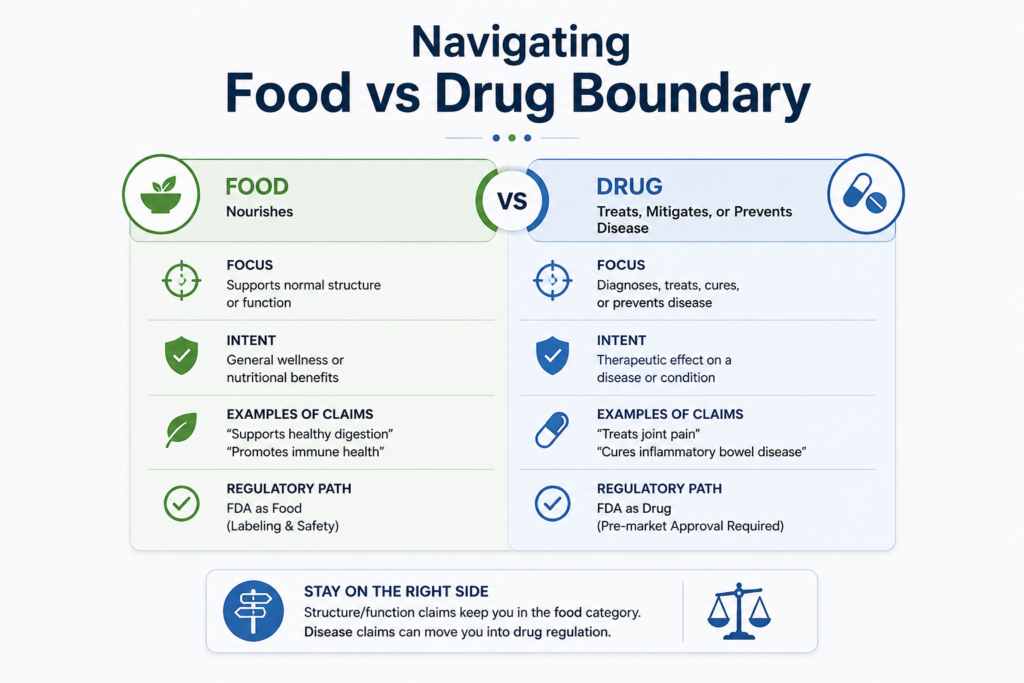
If your packaging or digital marketing crosses the line into therapeutic disease claims, the product is immediately classified as an unapproved new animal drug. This designation makes the item subject to border seizure, confiscation, and federal destruction.
Step 4: Mastering Pet Food Label Compliance
U.S. pet food labeling regulations are detailed and demanding. Labels must simultaneously satisfy general FDA consumer packaging requirements and individual state-level feed laws, which closely follow the structural templates established by AAFCO.
Required On-Label Elements
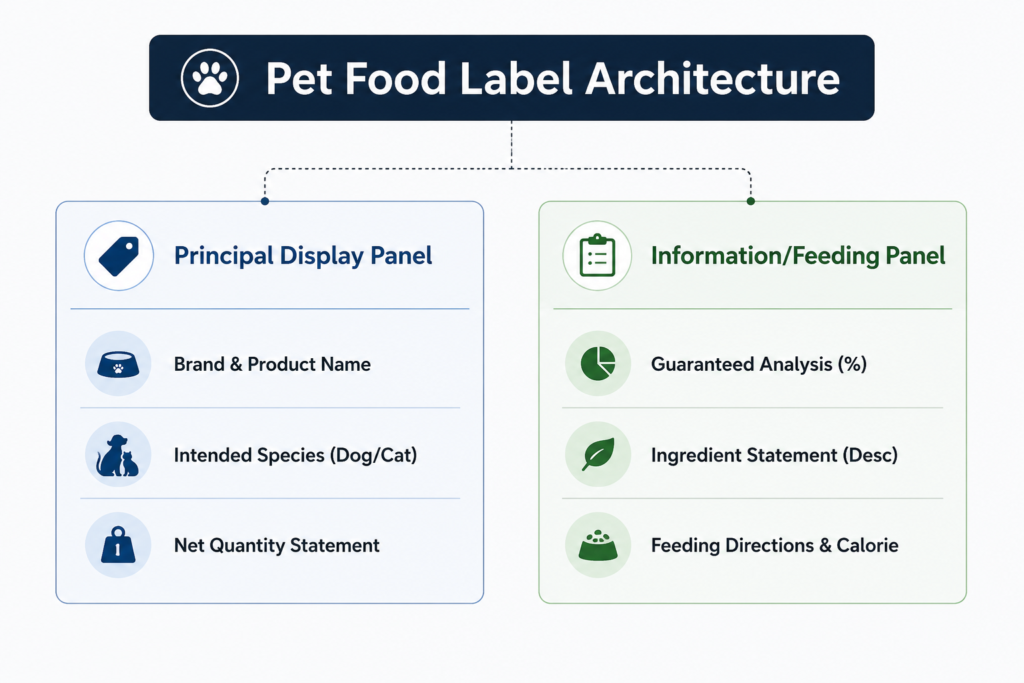
Every consumer-facing package of dog or cat food entering the United States must display a split panel layout divided into a Principal Display Panel (PDP) and an Information Panel. The following core components must be presented with absolute accuracy:
- Brand and Product Name: The chosen title must accurately convey the nature of the product without being misleading. If the label claims a product is a “Beef Dog Food,” the formula must meet specific AAFCO percentage thresholds for beef content based on weight.
- Intended Species Identification: The label must explicitly state the targeted animal species prominently on the main panel (e.g., “Premium Treats for Adult Dogs” or “Complete Food for Kittens”).
- Net Quantity Statement: The statement of net weight must appear within the bottom third of the PDP, formatted in both U.S. Customary units (ounces/pounds) and Metric units (grams/kilograms). It must adhere to strict font size and spacing rules based on the overall surface area of the package.
- Guaranteed Analysis: This mandatory section lists the nutrient profile of the product. It must state the minimum percentages of crude protein and crude fat, alongside the maximum percentages of crude fiber and moisture. Depending on the claims made on the packaging, additional guarantees for minerals, vitamins, or specialty items (like Omega fatty acids) may also be legally required.
- Ingredient Statement: Every single raw material must be listed in descending order of predominance by total weight before processing. All ingredients must be described using their official AAFCO recognized names. Broad, generic terms like “meat” or “local spices” are completely illegal; the label must specify exact components like “deboned beef” or “ground yellow corn.”
- Feeding Directions: Any product labeled as a complete and balanced life-stage food must provide clear, functional feeding instructions detailing how much of the product should be given to an animal based on its body weight.
- Manufacturer/Distributor Identification: The label must state the business name and physical street address of either the Mexican manufacturer or the authorized U.S. distributor, pre-faced by phrases like “Manufactured by…” or “Distributed by…”
Common Pet Food Labeling Errors
- Incorrect Weight-Based Groupings: Grouping divergent ingredients under single, vague categories.
- Missing Calorie Content Statements: Under AAFCO standards, labels must include a separate calorie statement expressed in terms of metabolizable energy (ME) on a per-kilogram and per-piece/cup basis (e.g., kcal/kg).
- Improper “Natural” Claims: Using the word “Natural” when the formula includes synthetic vitamin packs, trace minerals, or artificial preservatives, without featuring the mandatory qualifying footnote: “Natural with added vitamins, minerals, and trace nutrients.”
Step 5: Critical USDA-APHIS Interventions & Import Permits
While the FDA governs overall product safety and label transparency, the USDA Animal and Plant Health Inspection Service (APHIS) acts as a strict biosecurity gatekeeper. If your Mexican pet food contains any animal-derived ingredients, navigating APHIS protocols is often the most demanding part of the compliance process.
The Biosecurity Risk Assessment
APHIS regulates items derived from livestock, poultry, birds, equine species, and marine wildlife. If your product contains beef, pork, poultry fat, chicken meal, egg products, or dairy solids, APHIS will evaluate your application based on the disease status of the country and region of origin. The agency looks for risks related to major livestock diseases, including Foot-and-Mouth Disease (FMD), Classical Swine Fever (CSF), and Highly Pathogenic Avian Influenza (HPAI).
Obtaining Form VS 16-3 (Import Permit)
For many complex or multi-ingredient pet treats and pet foods coming from Mexico, the U.S. importer must secure an official USDA Import Permit for Animal Products and By-Products (VS Form 16-3) before any commercial freight leaves the manufacturing facility. This permit outlines the specific entry conditions, approved ports of entry, mandatory routing steps, and documentation requirements that must accompany the shipment.
Foreign Government Certification via SENASICA
An APHIS import permit typically requires each shipment to be accompanied by an official veterinary health certificate issued by SENASICA (Servicio Nacional de Sanidad, Inocuidad y Calidad Agroalimentaria), Mexico’s federal agricultural safety authority.
This certificate serves as official government confirmation that the processing facility operates under national veterinary inspection. It also verifies that the animal raw materials were sourced from healthy animals fit for consumption, and that the products underwent specialized thermal processing (such as core temperature pasteurization) sufficient to neutralize any targeted viral or bacterial pathogens.
If the processing parameters, raw material certificates, or temperature logs do not line up perfectly with the conditions listed on the USDA-APHIS import permit, the entire shipment will be stopped at the border crossing.
How FDA Consults Empowers Mexican Exporters to Succeed
The U.S. regulatory system is designed to protect animal and public health, but its complex requirements can feel like a major trade barrier for Mexican companies. You do not have to manage these technical challenges alone. FDA Consults specializes in helping Mexican agricultural, treat, and pet food manufacturers navigate the complexities of U.S. compliance. Located close to the FDA headquarters, our firm provides the technical expertise, strategic guidance, and hands-on support needed to move your products smoothly across the border. Our specialized services include:
- Official U.S. Agent Representation: Giving your facility a permanent, expert regulatory presence in the United States that is ready to handle federal communications 24/7.
- AAFCO Label & Formula Audits: Thoroughly reviewing your ingredient lists, package text, and claims to eliminate compliance risks before you begin printing.
- USDA-APHIS & SENASICA Coordination: Helping your team secure necessary import permits and align your processing documentation with federal biosecurity standards.
- FSVP Compliance Support: Building professional, audit-ready safety documentation packets that assure your U.S. buyers your facility is a safe, reliable partner.
- FDA Inspection Preparation: Conducting mock audits and training your quality control staff so your facility can pass on-site federal inspections with confidence.
Lets work together
If you are preparing to enter the U.S. market or need reliable FDA registration and U.S. Agent support, our team is ready to assist you. Contact FDA Consults today to discuss your compliance needs.