

FSSAI vs. US FDA: Why Indian Spice & Food Exporters Face Detentions
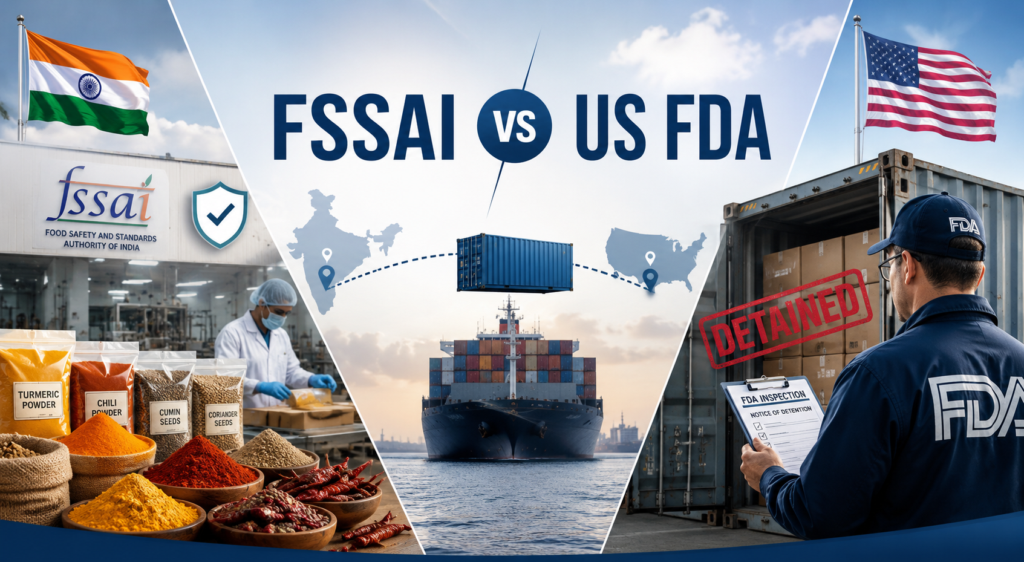
FSSAI vs. US FDA: Why Indian Spice & Food Exporters Face Detentions. India remains the “Spice Bowl of the World,” supplying a vast range of spices, herbs, extracts, and processed food ingredients to global markets. From turmeric and cumin to cardamom, chili powder, and spice blends, India accounts for more than 12% of global spice trade, exporting to over 180 countries. For decades, Indian exporters have successfully built global markets based on quality, tradition, and large-scale agricultural production. However, 2026 marks a turning point in how food imports into the United States are evaluated.
The regulatory environment in the United States has changed dramatically.
The U.S. Food and Drug Administration (FDA), under its Human Foods Program (HFP) restructuring, has significantly intensified its enforcement on chemical safety, microbial contamination, traceability, and preventive controls. As a result, the rate at which Indian food shipments are detained or refused has increased sharply. Recent import data indicates that Indian food shipments face refusal rates nearly seven times higher than those of other large exporters such as China or Mexico. Spices, herbal products, and processed foods are among the most frequently detained categories.
For Indian exporters, the most important reality to understand is this:
FSSAI approval is a domestic license — it is not a passport to the American market.
Many exporters assume that if their facility is compliant with India’s Food Safety and Standards Authority of India (FSSAI) regulations, their product will automatically meet international standards. Unfortunately, this assumption often leads to costly shipment detentions at U.S. ports.
To successfully export to the United States in 2026 and beyond, Indian exporters must navigate several key regulatory differences between FSSAI and the U.S. FDA. These differences can be understood through three major regulatory “clashes” that frequently lead to import detentions.
1. The Traceability Clash: FSMA 204 & The 24-Hour Rule
One of the most significant operational shifts affecting exporters in 2026 comes from FSMA Section 204, part of the Food Safety Modernization Act (FSMA). FSMA fundamentally transformed how the United States regulates food safety by shifting the focus from reactive enforcement to preventive controls and traceability.
Section 204 specifically addresses enhanced traceability requirements for high-risk foods included on the FDA’s Food Traceability List (FTL).
Many spice ingredients and food products commonly exported from India fall into this category, including:
- Nut butters
- Certain spice blends
- Ingredients used in ready-to-eat foods
- Products associated with previous outbreaks
The 24-Hour Digital Mandate
Under the 2026 enforcement environment, if the FDA suspects a contamination event — such as a Salmonella outbreak linked to black pepper or chili powder — companies must provide detailed traceability records within 24 hours.
These records must be provided in a sortable electronic format, typically a spreadsheet containing traceability data.
This requirement includes providing Key Data Elements (KDEs) for every Critical Tracking Event (CTE) in the product’s lifecycle.
Critical Tracking Events may include:
- Harvesting
- Initial processing
- Packing
- Transformation or blending
- Shipping
- Importation into the United States
Each step must be digitally documented and linked through lot codes and traceability identifiers.
The FSSAI Reality
In India, many Food Business Operators (FBOs) still rely on manual documentation systems.
Typical recordkeeping methods include:
- Paper-based lot tracking
- Warehouse logs
- Supplier invoices
- Manual batch sheets
While these systems may meet FSSAI compliance requirements, they often fail to meet the digital traceability expectations of the FDA.
The FDA Reality
The FDA expects companies to produce traceability data immediately and electronically.
If an exporter cannot produce digital records showing the product’s complete supply chain history, the FDA may detain the shipment under the violation:
“Failure to establish or maintain required records.”
This often results in:
- Shipment delays
- Refusal of entry
- Additional inspections
- Increased scrutiny of future shipments
For exporters shipping high-risk foods, implementing digital traceability systems is no longer optional — it is essential for market access.
2. The “Closer to Zero” Clash: New 2026 Heavy Metal Action Levels
Another growing source of detention for Indian spices relates to heavy metal contamination, particularly lead and cadmium. In early 2026, the FDA accelerated its “Closer to Zero” initiative, a long-term strategy designed to reduce toxic element exposure in foods. The initiative focuses heavily on foods consumed by infants, children, and vulnerable populations, including spices commonly used in household cooking.
Turmeric & Cinnamon Under the Microscope
Turmeric has become one of the most closely monitored spices due to a well-documented adulteration issue.
The Problem:
In some cases, turmeric powder is illegally adulterated with lead chromate, a compound used to enhance the bright yellow color of turmeric. This practice significantly increases lead concentrations and poses serious health risks. Even without adulteration, natural soil contamination in certain regions of India can cause elevated heavy metal levels. Some turmeric samples have recorded lead levels exceeding 6,000 ppb (parts per billion).
The 2026 Standard
Historically, the FDA addressed heavy metal contamination on a case-by-case basis, evaluating each shipment individually. However, under the Closer to Zero initiative, the agency is moving toward clearer and stricter action thresholds.
For comparison:
- The European Union already enforces a 0.80 mg/kg limit for fresh turmeric.
- The FDA is now pushing toward lower allowable levels, particularly when spices are used in foods consumed by children.
As regulatory pressure increases, shipments exceeding these levels are likely to be detained more frequently.
The Import Alert
If a facility is associated with heavy metal contamination, it may be placed under:
Import Alert 99-42
Once placed on this alert, the facility’s shipments are subject to Detention Without Physical Examination (DWPE). This means that future shipments can be automatically detained without laboratory testing, based solely on the exporter’s compliance history.
Getting removed from DWPE often requires:
- Multiple consecutive clean shipments
- Independent laboratory verification
- Formal petitions to the FDA
This process can take months or even years.
3. The Pesticide Clash: FSSAI “Default” vs. US EPA “Zero Tolerance”
One of the most misunderstood regulatory differences between India and the United States involves pesticide residue limits. Many exporters mistakenly assume that if their product complies with FSSAI Maximum Residue Limits (MRLs), it will automatically meet U.S. standards. In reality, the U.S. system operates very differently.
The Default Limit Trap
In 2024 and 2025, FSSAI increased the default Maximum Residue Limit (MRL) for many pesticides in spices to 0.1 mg/kg when specific residue data was unavailable. This change was intended to simplify enforcement within India. However, this approach does not align with the regulatory framework used in the United States.
The US FDA Standard
In the U.S., pesticide tolerances are established by the Environmental Protection Agency (EPA).
The EPA sets specific tolerance levels for:
- Individual pesticides
- Specific crops or foods
If the EPA has not established a tolerance for a pesticide on a specific spice, then the allowable limit is effectively zero.
This is often interpreted as the limit of quantification, meaning that even very small detectable residues may lead to regulatory action.
The Result
This difference creates a dangerous regulatory trap. A spice shipment that is perfectly legal under FSSAI’s 0.1 mg/kg limit may be considered “adulterated” under U.S. law if the pesticide detected does not have an approved EPA tolerance for that specific spice.
This situation frequently occurs with:
- Chili powder
- Cumin
- Coriander
- Mixed spice blends
Once detected, the shipment may be:
- Refused entry
- Placed under Import Alert
- Subjected to increased future inspections
For exporters, understanding the EPA tolerance database is essential before shipping products to the United States.
4. Why Salmonella Remains the #1 Reason for Refusal
Despite advances in chemical testing and traceability systems, microbial contamination remains the single largest reason for FDA import refusals. Salmonella contamination continues to appear in hundreds of spice shipment detentions each year. In the most recent reporting cycle, nearly 500 Indian shipments were refused due to Salmonella detection.
Zero Tolerance Enforcement
Under Import Alert 99-19, the FDA enforces a zero tolerance policy for Salmonella in spices. This rule applies regardless of the intended use of the spice. Even if the spice will be cooked before consumption, the FDA still considers Salmonella contamination unacceptable.
Products frequently affected include:
- Black pepper
- Chili powder
- Turmeric
- Spice blends
- Sesame-based products
Once a facility is placed on Import Alert 99-19, shipments are typically detained automatically until the exporter demonstrates consistent compliance.
This often requires:
- Salmonella-free test results
- Accredited laboratory verification
- Enhanced preventive controls
Strategic Solution: The “Maryland Advantage”
Navigating FDA detentions requires more than simply submitting laboratory results. The U.S. regulatory system operates on strict documentation timelines, technical responses, and procedural compliance.
When the FDA issues a Notice of Action under import alerts such as:
- Import Alert 16-81
- Import Alert 28-02 (Black Pepper from India)
Exporters are typically given only 10 working days to submit a formal response.
This response may include:
- Scientific testimony
- Laboratory analysis
- Reconditioning proposals
- Corrective action plans
Local Representation Matters
Having a regulatory liaison within the United States can significantly improve response efficiency. Our office in Columbia, Maryland, provides direct support for exporters dealing with FDA import enforcement.
We assist exporters by:
Coordinating with LAAF-accredited laboratories
Laboratory Accreditation for Analyses of Foods (LAAF) became mandatory for certain compliance testing in 2026, particularly for Salmonella release testing.
Submitting electronic reconditioning plans
If a shipment is detained, it may be possible to submit a Reconditioning Proposal (FDA Form 766) explaining how the product will be brought into compliance.
These submissions must be prepared carefully and sent to the FDA Compliance Officer overseeing the case.
Reviewing Foreign Supplier Verification Programs (FSVP)
Sometimes the issue lies not with the exporter but with the U.S. importer’s FSVP documentation. If the importer cannot demonstrate proper supplier verification, the shipment may still be detained. A thorough FSVP review ensures that both sides of the supply chain meet regulatory expectations.
Final Thoughts
India’s spice industry remains one of the most important agricultural export sectors in the world. However, the regulatory expectations of importing countries — especially the United States — are becoming increasingly complex.
For Indian exporters, success in 2026 will require:
- Digital traceability systems
- Heavy metal monitoring
- EPA-compliant pesticide testing
- Robust microbial controls
Companies that adapt quickly will continue to thrive in the U.S. market.
Those that rely solely on FSSAI compliance as proof of export readiness risk costly detentions, shipment refusals, and long-term regulatory restrictions. Don’t let your legacy export business become a legal liability.