1. The New Mandatory Entity: The “Responsible Person”
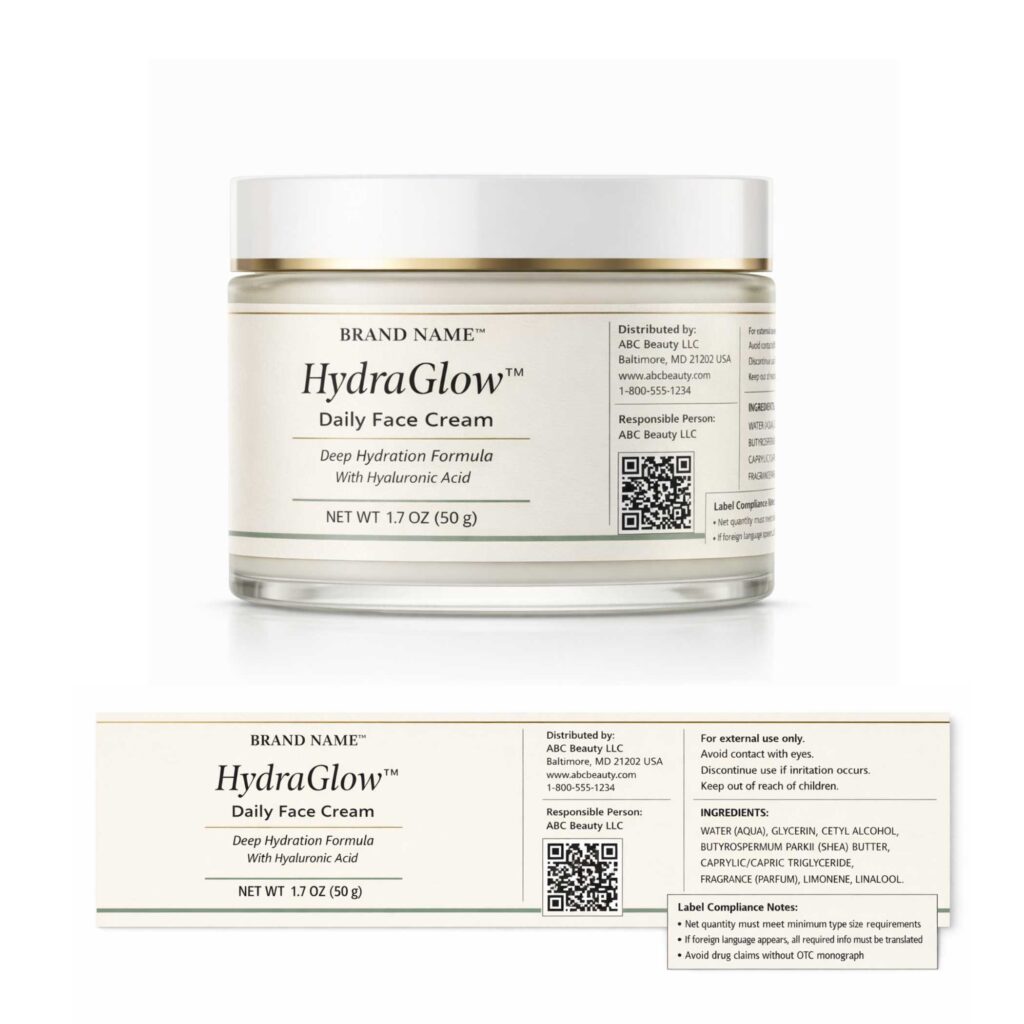
Under MoCRA, every cosmetic label must clearly identify a Responsible Person (RP). This is not just a name on a box; it is the entity legally accountable for:
Adverse Event Reporting: Managing and submitting reports to the FDA.
Safety Substantiation: Maintaining records that prove the product is safe for use.
Product Listing: Ensuring the product is registered in the FDA’s Cosmetics Direct portal.
The Label Change: Traditionally, you listed the manufacturer, packer, or distributor. Now, that listed entity is legally the “Responsible Person.” If your name is on the label, the FDA holds you responsible for every safety data point
2. Mandatory Adverse Event Contact Information
One of the most visible changes in 2026 is the requirement for Adverse Event Contact Info. Consumers must have a direct, easy way to report a reaction (rash, burn, or hair loss) to you.
What must be on the label?
You are now required to include one of the following on the retail packaging:
- A Domestic U.S. Address: A full physical address where mail can be received.
- A Domestic U.S. Phone Number: A working line for consumer reporting.
- Electronic Contact Information: This can be a website URL or an email address.
Expert Tip: Many brands are opting for a QR code that leads directly to a digital reporting form. This saves space on small components like lipsticks or eye pencils while satisfying the “electronic contact” requirement.
3. Fragrance Allergen Disclosure: The May 2026 Update
Historically, brands could simply list “Fragrance” or “Parfum” to protect trade secrets. MoCRA has ended this.
- The Proposed Rule: The FDA is scheduled to publish the final list of Mandatory Fragrance Allergens by May 2026.
- The Threshold: Once finalized, you must list specific allergens (such as Limonene, Linalool, or Citral) if they exceed a certain percentage in the formula—even if they are part of a proprietary fragrance blend.
Action for 2026: Brands should already be requesting “Allergen Breakdowns” from their fragrance houses to ensure they can update their ingredient lists the moment the FDA list is finalized.
4. Professional Use Only Labeling
If you manufacture products intended only for use by licensed professionals (e.g., salon-strength chemical peels or hair straighteners), your label must now bear a conspicuous statement:
“Administered or used only by licensed professionals.”
This is an enforcement priority for 2026 as the FDA cracks down on “professional-strength” products being sold directly to untrained consumers online.
5. Standard Labeling Fundamentals (Still in Effect)
While MoCRA added new layers, the foundational requirements of 21 CFR 701 still apply. Your 2026 master label must still include:
| Requirement |
Description |
Location |
| Statement of Identity |
Common name of the product (e.g., “Face Cream”) |
Principal Display Panel (PDP) |
| Net Quantity |
Weight or volume in both U.S. and Metric units |
Bottom 30% of the PDP |
| Ingredient Declaration |
Listed in descending order of predominance |
Any accessible surface |
| Warning Statements |
Specific warnings for aerosols, sunscreens, etc. |
Conspicuous placement |
6. 2026 Compliance Checklist for Brands
To stay “Active” in the FDA’s eyes this year, ensure you have checked the following:
- Biennial Renewal: If you registered your facility in early 2024, your Biennial Renewal is due in 2026.
- Safety Substantiation: Do you have a “Product Information File” (PIF) ready for an FDA inspector?
- Color Additives: Are your colors U.S.-certified? (e.g., using “Red 7 Lake” instead of “CI 15850”).
- U.S. Agent: If you are a foreign manufacturer, is your U.S. based Agent active and listed on your registration?
7. Why Labels Fail ?
Most detentions happen not because a product is “dangerous,” but because it is “Misbranded.” Common errors include:
- Drug Claims: Saying a cream “cures acne” or “removes wrinkles” makes it a drug. In the U.S., these require an OTC Monograph or New Drug Application (NDA).
- Language Issues: If any part of the label is in a foreign language, all required information must be translated.
- Font Size: The “Net Quantity” has specific height requirements based on the size of the package. If it’s 1/16th of an inch too small, the shipment can be seized.
MoCRA has brought the U.S. cosmetic market closer to the regulatory standards of the EU and Canada. By integrating these 2026 updates into your labeling process now, you aren’t just following the law—you are building a “Trust Asset” for your brand.
Ready to launch in the U.S.? Download our MoCRA Cosmetic Label Template or contact FDA Consults for a professional Label Audit to ensure your brand is protected.